
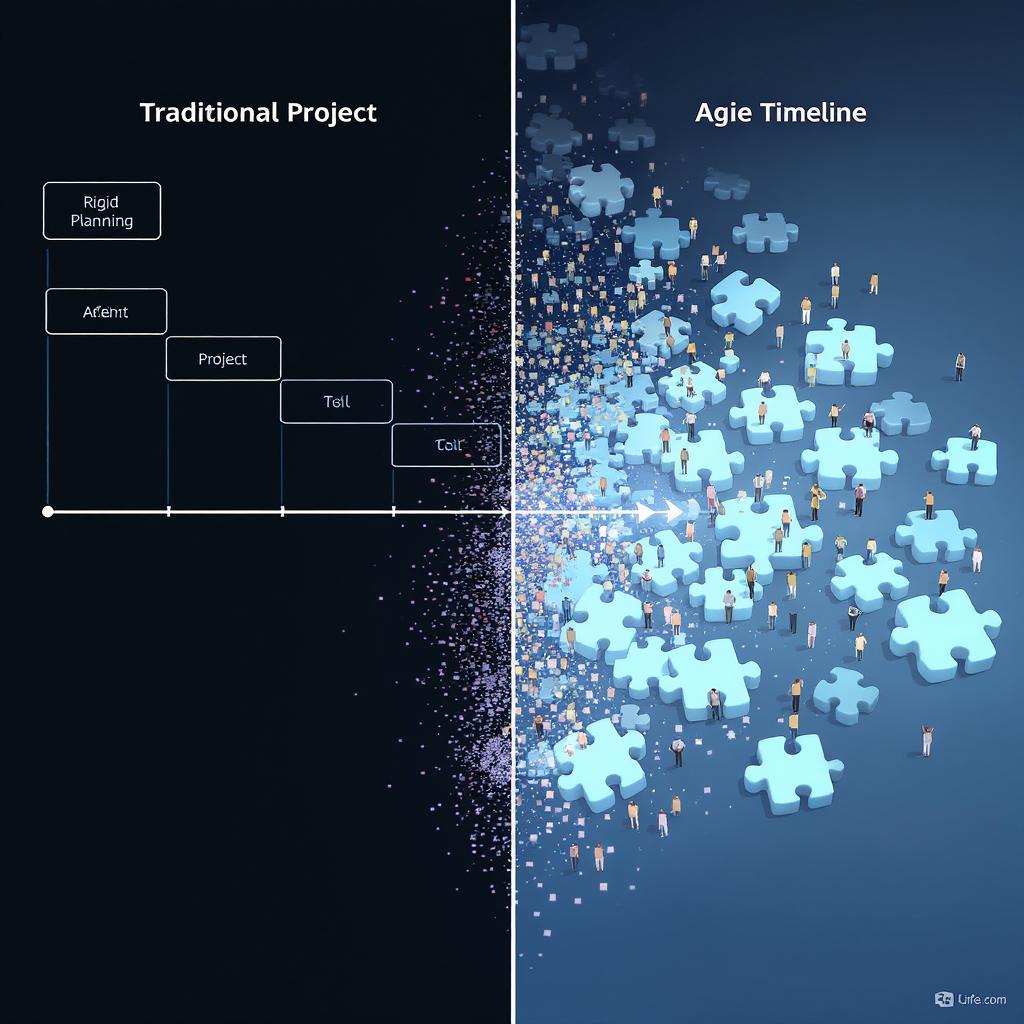
The best plans are written in pencil, but the best projects are built with erasers.
The Crisis That Changed Everything
Picture this: You’re six months into what should be a textbook software implementation. Gantt charts perfectly aligned, milestones hitting like clockwork, stakeholders nodding approvingly in monthly reviews. Then your phone rings at 7:47 AM on a Tuesday.
“We need to talk. The entire market landscape just shifted. We’re pivoting the project 180 degrees. Can you be here in an hour?”
This wasn’t a drill. This was my reality three years ago, managing a critical digital transformation for a Fortune 500 manufacturing giant. What happened next became the defining moment of my project management career—and the birth of my personal Agile philosophy that goes far beyond what any certification manual teaches.
The Waterfall Trap That Nearly Killed Us
The Comfortable Lie of Perfect Planning
For the first six months, we were the poster child of traditional project management. Our project plan was a 47-page masterpiece with dependencies mapped to the hour. Risk registers color-coded in beautiful shades of green, yellow, and red. Weekly status reports that would make any PMO director weep with joy.
We had:
- 247 detailed work breakdown structure elements
- Resource allocation planned 18 months in advance
- Change control board meetings scheduled monthly
- Quality gates that required 14 different sign-offs
- Documentation standards that NASA would envy
When Reality Comes Knocking
But here’s what no project management textbook prepares you for: markets don’t read your project charter. Competitors don’t respect your milestone dates. And customer needs definitely don’t wait for your phase gate approvals.
The pivot wasn’t just a feature change—it was fundamental. We were building a customer relationship management system, and suddenly the client needed a supply chain optimization platform. Same budget, same timeline, completely different universe of requirements.
Under traditional waterfall methodology, this would mean:
- 6-8 weeks for change impact analysis
- Complete requirements re-gathering (4-6 weeks)
- Architecture redesign and approval (3-4 weeks)
- New resource allocation and contracting (2-3 weeks)
- Updated project plan approval through governance (2 weeks)
Total delay: 17-27 weeks. Project death sentence: Confirmed.
The Agile Awakening: More Than Methodology, It’s Survival
Week 1: Emergency Sprint Zero
Instead of panicking, we called an emergency “Sprint Zero.” Not because the Scrum guide told us to, but because survival demanded it.
Day 1: Assembled a war room with key stakeholders
- Client C-level executives
- Technical architects
- Business analysts
- End-user representatives
- External vendor partners
Day 2-3: Rapid requirements discovery using Design Thinking
- Empathy mapping for new user personas
- Journey mapping for supply chain processes
- Ideation sessions for MVP features
- Quick prototype sketches
Day 4-5: High-level solution architecture
- Technology stack evaluation
- Integration point mapping
- Data migration strategy outline
- Security and compliance quick assessment
Week 2: The Power of Iterative Thinking
We didn’t try to solve everything. We focused on one question: “What’s the smallest valuable thing we can deliver in two weeks?”
The answer changed everything.
Instead of planning a complete supply chain system, we identified the most critical pain point: inventory visibility across three manufacturing plants. If we could solve just that, we’d deliver immediate value while buying time to build the rest.
Sprint 1 Goal: Real-time inventory dashboard for Plant Operations Manager
- Connect to existing ERP systems
- Simple visual interface showing stock levels
- Basic alerting for critical shortages
- Mobile-responsive for plant floor usage
Week 3: Daily Standups Became Strategic Sessions
Forget the “what did you do yesterday, what will you do today, any blockers” routine. Our daily standups became 15-minute strategy sessions:
Monday: Market intelligence sharing Tuesday: Technical feasibility discussions
Wednesday: Stakeholder feedback integration Thursday: Risk and issue rapid response Friday: Week retrospective and next sprint planning
Each standup had one rule: every person had to share one insight that could change our approach. No status updates, only intelligence.
Week 4: First Value Delivery
We delivered the inventory dashboard. Not perfect, not complete, but working and valuable.
The Plant Operations Manager’s reaction: “This is exactly what I needed. Can you add supplier lead time predictions next?”
That question became Sprint 2’s focus. The project wasn’t just surviving—it was evolving based on real user feedback.
The Hidden Agile Principles That Textbooks Miss
Principle 1: Antifragility Over Resilience
Nassim Taleb taught us that some things don’t just resist stress—they improve because of it. This project became antifragile.
Traditional Approach: Build comprehensive requirements to prevent change Agile Reality: Build systems that improve through change
Every pivot, every new requirement, every stakeholder feedback session made our solution stronger because we designed it to absorb and capitalize on change.
Principle 2: Stakeholder Intimacy, Not Management
We stopped “managing” stakeholders and started building intimacy with them.
Old way: Monthly steering committee meetings with PowerPoint updates New way: Daily Slack channels, weekly working sessions, bi-weekly coffee chats
The Client CEO started joining our sprint reviews. Not because he had to, but because he was genuinely curious about what we’d discover next.
Principle 3: Value Obsession Over Process Compliance
Every decision came down to one question: “Does this add value to the end user?”
Documentation: Only what helps the team deliver value Meetings: Only if they generate actionable insights Tools: Only if they accelerate delivery Processes: Only if they prevent value destruction
The Corporate Reality Check: Agile in Large Organizations
The Politics of Change
Implementing true Agile in a Fortune 500 environment isn’t just about changing methodology—it’s about changing organizational DNA.
Challenge 1: Budget approval processes designed for waterfall Solution: Demonstrated value delivery every two weeks to maintain funding confidence
Challenge 2: Legal and compliance requirements expecting detailed documentation Solution: Created “living documentation” that evolved with the solution
Challenge 3: Vendor management processes expecting fixed scope contracts Solution: Negotiated outcome-based contracts with built-in flexibility clauses
The Stakeholder Ecosystem Evolution
Our stakeholder map transformed from a traditional hierarchy to a dynamic network:
Traditional Stakeholder Management:
- Project Sponsor (approves/rejects)
- Steering Committee (governs)
- End Users (receive)
- IT Department (implements)
Agile Stakeholder Network:
- Value Champions (evangelists for user needs)
- Technical Collaborators (co-create solutions)
- Business Partners (share domain expertise)
- Innovation Catalysts (challenge assumptions)
The Measurement Revolution: Beyond Burndown Charts
Metrics That Actually Matter
We abandoned traditional project metrics for value-based indicators:
Instead of: Percentage complete We tracked: User adoption rates
Instead of: Budget variance We tracked: Value delivered per dollar spent
Instead of: Schedule adherence We tracked: Time to value realization
Instead of: Scope completion We tracked: Problem resolution effectiveness
The Customer Satisfaction Algorithm
We developed a simple but powerful formula:
Project Success = (Value Delivered × Speed to Market) ÷ (Effort Required × Risk Introduced)
This formula guided every sprint planning session and helped us make trade-off decisions that maximized overall project success.
Crisis Management Through Agile Lens
The Three Emergency Protocols
During the project, we faced three major crisis situations. Each time, our Agile approach turned potential disasters into opportunities:
Crisis 1: Key vendor partnership dissolved mid-project Agile Response: Rapid prototyping with three alternative vendors in parallel Outcome: Found a better solution at 30% lower cost
Crisis 2: Regulatory requirements changed, affecting core functionality Agile Response: Created compliance sprint with legal and technical teams Outcome: Built more robust security features that became selling points
Crisis 3: Primary stakeholder left the company Agile Response: Knowledge transfer sessions with entire user community Outcome: Discovered new requirements that significantly improved the solution
The Pivot Playbook
When major changes hit, we followed a 72-hour response protocol:
Hour 0-24: Impact assessment and stakeholder communication Hour 24-48: Solution ideation and feasibility analysis Hour 48-72: Decision making and sprint re-planning
This rapid response capability became one of our competitive advantages.
The Technical Architecture of Adaptability
Building for Change
Our technical decisions reflected Agile principles:
Microservices Architecture: Each component could evolve independently API-First Design: Integration points designed for future flexibility Cloud-Native Deployment: Scaling and modification without infrastructure constraints Automated Testing: Confidence to make changes without breaking existing functionality
The DevOps Integration
Agile project management without DevOps is like having a sports car with bicycle tires. We integrated:
Continuous Integration: Code changes validated within hours Automated Deployment: New features in production within days Infrastructure as Code: Environment changes tracked and versioned Monitoring and Alerting: Real-time visibility into system health
The Human Element: Team Dynamics in High-Pressure Agile
Psychological Safety as a Success Factor
The project’s success wasn’t just about methodology—it was about creating an environment where people could take intelligent risks.
Permission to Fail: Every sprint retrospective celebrated intelligent failures Collective Ownership: No individual blame for team challenges Transparent Communication: Bad news traveled as fast as good news Continuous Learning: Every team member had a learning goal each sprint
The Cross-Functional Team Evolution
Our team composition evolved throughout the project:
Sprint 1-5: Core technical team with business analyst Sprint 6-10: Added UX designer and data scientist Sprint 11-15: Integrated customer service and training specialists Sprint 16-20: Included vendor partners and client IT staff
Each addition brought new perspectives that improved our solution.
Financial Impact: The Numbers Behind the Success
The Investment Analysis
Total Project Investment: $1.8M over 20 sprints Traditional Approach Estimate: $2.4M over 18 months (before the pivot) Actual Agile Delivery: $1.6M over 14 months
Value Delivered:
- 40% reduction in inventory carrying costs
- 60% improvement in supply chain visibility
- 25% decrease in stockout incidents
- 15% improvement in supplier relationship scores
ROI Calculation: 340% within first year of operation
The Hidden Cost Savings
Beyond direct project costs, the Agile approach generated unexpected savings:
Change Management: $200K saved through incremental user adoption Training: $150K saved through built-in user feedback loops Support: $100K annual savings through intuitive interface design Maintenance: 30% reduction in ongoing support costs
Lessons for Fellow Project Managers
The Five Non-Negotiable Mindset Shifts
1. From Certainty to Curiosity Stop pretending you know everything upfront. Embrace the questions you haven’t asked yet.
2. From Control to Influence You can’t control outcomes, but you can influence the probability of success.
3. From Plans to Principles Plans become obsolete, but principles guide you through uncertainty.
4. From Individual Achievement to Team Success Your success is measured by what your team accomplishes, not what you personally deliver.
5. From Process Compliance to Value Creation Follow processes that create value, abandon those that don’t.
The Corporate Agile Survival Kit
Tool 1: Stakeholder Network Map (not hierarchy chart) Tool 2: Value Stream Canvas (not work breakdown structure) Tool 3: Risk-Opportunity Matrix (not traditional risk register) Tool 4: Learning Backlog (not just product backlog) Tool 5: Impact Measurement Dashboard (not status report)
The Ripple Effect: Beyond One Project
Organizational Transformation
The success of this project catalyzed broader organizational changes:
Executive Level: C-suite began requesting “Agile approaches” for other initiatives Middle Management: Department heads started adopting iterative planning cycles Team Level: Cross-functional collaboration became the norm, not exception
The Consulting Opportunity
The client was so impressed with the approach that they asked us to help implement similar methodologies across their other divisions. This led to:
- $2.3M in additional consulting contracts
- Long-term strategic partnership agreement
- Reference customer for similar engagements
- Case study for executive speaking engagements
Industry Recognition
The project became a case study that I’ve presented at:
- PMI Global Conference (keynote presentation)
- Agile Alliance events (workshop facilitator)
- Corporate training programs (guest lecturer)
- Industry publications (featured article author)
The Future of Project Management: Agile Evolution
Beyond Scrum and Kanban
The project taught me that true Agile isn’t about following frameworks—it’s about embodying principles that help organizations thrive in uncertainty.
Emerging Trends I’m Tracking:
- AI-augmented sprint planning
- Predictive analytics for backlog prioritization
- Virtual reality for remote team collaboration
- Blockchain for transparent stakeholder voting
- IoT integration for real-time project metrics
The Next Generation of Project Managers
Future project managers will need to be:
Anthropologists: Understanding organizational culture and human behavior Data Scientists: Making decisions based on evidence, not intuition Systems Thinkers: Seeing connections across organizational boundaries Change Catalysts: Helping organizations evolve, not just deliver projects Value Architects: Designing experiences, not just managing tasks
Conclusion: Your Agile Journey Starts Now
This project didn’t just save $2.3M or deliver a successful system. It fundamentally changed how I approach every challenge in my professional life.
The question isn’t whether you should adopt Agile methodologies. The question is whether you’re ready to embrace the mindset that turns uncertainty from a threat into a competitive advantage.
Every project you manage is an opportunity to practice this mindset. Every stakeholder interaction is a chance to build trust through transparency. Every sprint is a laboratory for learning what works and what doesn’t.
The corporate world doesn’t need more project managers who can follow process guides. It needs leaders who can navigate complexity, build adaptive systems, and create value in the face of constant change.
Your next project is waiting. The only question is: will you manage it, or will you transform it?
The choice, as always, is yours.
Leave a Reply
You must be logged in to post a comment.