
1. Setting the Stage: Florence, the Innovation Capital of the 15th Century
Long before Silicon Valley became the global symbol of creativity, the streets of Florence were buzzing with intellectual energy. The city was a living, breathing ecosystem of experimentation. Artists, inventors, and merchants didn’t just coexist — they collaborated. Projects were commissioned, revised, paused, and resurrected depending on new discoveries or shifting priorities.
This was not chaos — it was early agility in motion.
The Medici family’s patronage created a culture where failure was not fatal; it was feedback. Workshops were funded not for single masterpieces but for the pursuit of progress. Each artisan’s experiment — from pigments to gears — contributed to collective learning.
2. The Studio as a Sprint Room
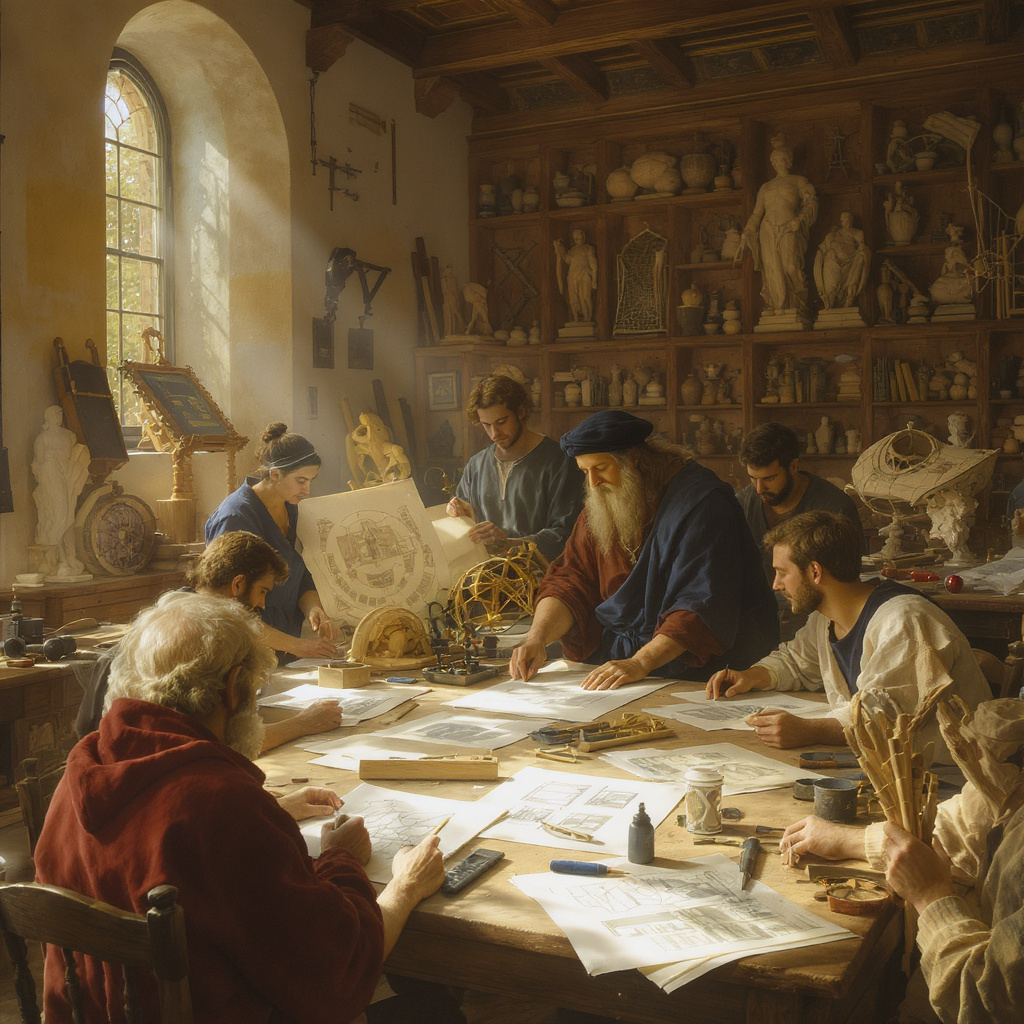
Leonardo da Vinci’s bottega (studio) was not a solitary artist’s den. It was a dynamic ecosystem of apprentices, engineers, mathematicians, and philosophers — all cycling through creative iterations.
- Every painting or invention began with a concept sketch — the first user story.
- Da Vinci would hold discussions (our equivalent of sprint planning) where ideas were dissected from multiple disciplines.
- As work progressed, he constantly reprioritized the backlog — deciding which invention to refine next or which painting deserved more attention.
He often left projects “unfinished,” not because of distraction, but because he was applying incremental improvement — refining until the next iteration felt meaningful.
3. Continuous Learning and Feedback Loops
In modern Agile environments, feedback drives direction. The same was true in Florence. Patrons like the Medici didn’t expect perfect delivery; they expected visible progress. Each iteration — a half-finished fresco, a working gear model, or a partial sculpture — served as a demonstration.
Leonardo’s notes read like retrospective reports: “Improved light reflection,” “muscle detail inconsistent,” “mechanism friction reduced.”
He practiced inspect and adapt centuries before it was named.
4. Cross-Functional Collaboration Before It Was Cool
One of the most profound integrations of Agile values was the merging of art and science.
Painters learned anatomy from physicians, architects borrowed geometry from astronomers, and metalworkers collaborated with sculptors. This dissolving of silos built a fertile ground for cross-functional delivery.
Even competition among workshops wasn’t destructive — it drove innovation through shared discovery. Knowledge wasn’t hoarded; it was iterated upon.
5. Managing Change Requests — The Renaissance Way
Renaissance projects were notorious for scope shifts: a duke would change a commission halfway, or funds would be redirected to another monument.
Rather than collapsing under the change, masters adapted — reusing partial work, redesigning based on constraints, or merging elements from prior designs.
Da Vinci’s unfinished “Adoration of the Magi” or his reworked sketches for “The Last Supper” are perfect case studies in responding to change over following a plan.
6. Burnout, Bottlenecks, and Balance
But it wasn’t all beauty. Renaissance workshops also faced intense pressures — tight patron timelines, conflicting visions, and apprentice burnout.
The management of creative energy became a leadership challenge. The masters learned the importance of pacing, delegation, and inspiration — what today’s Agile leads call sustainable development.
Da Vinci was known to pause projects deliberately, switching context to restore creative flow — a practice remarkably similar to today’s concept of sprint cool-downs.
7. Lessons for Today’s Agile Project Managers
- Curiosity is the ultimate Agile mindset. Don’t fear unfinished work; fear stagnant learning.
- Diverse teams outperform specialized silos. Cross-pollination fuels innovation.
- Iteration should create joy, not exhaustion. A sprint without reflection is just repetition.
- Stakeholder alignment isn’t documentation — it’s dialogue. Renaissance patrons didn’t read reports; they visited studios.
8. The Agile Renaissance in the Modern World
If Florence was the first Agile hub, today’s digital transformation programs are its modern reincarnation.
Whether in AI design, software sprints, or product innovation — success still depends on how well teams integrate imagination with execution.
So the next time your project sprint feels chaotic, remember: Da Vinci built helicopters without engines, bridges without blueprints, and machines powered only by curiosity. That’s agility in its purest form.
Leave a Reply
You must be logged in to post a comment.