
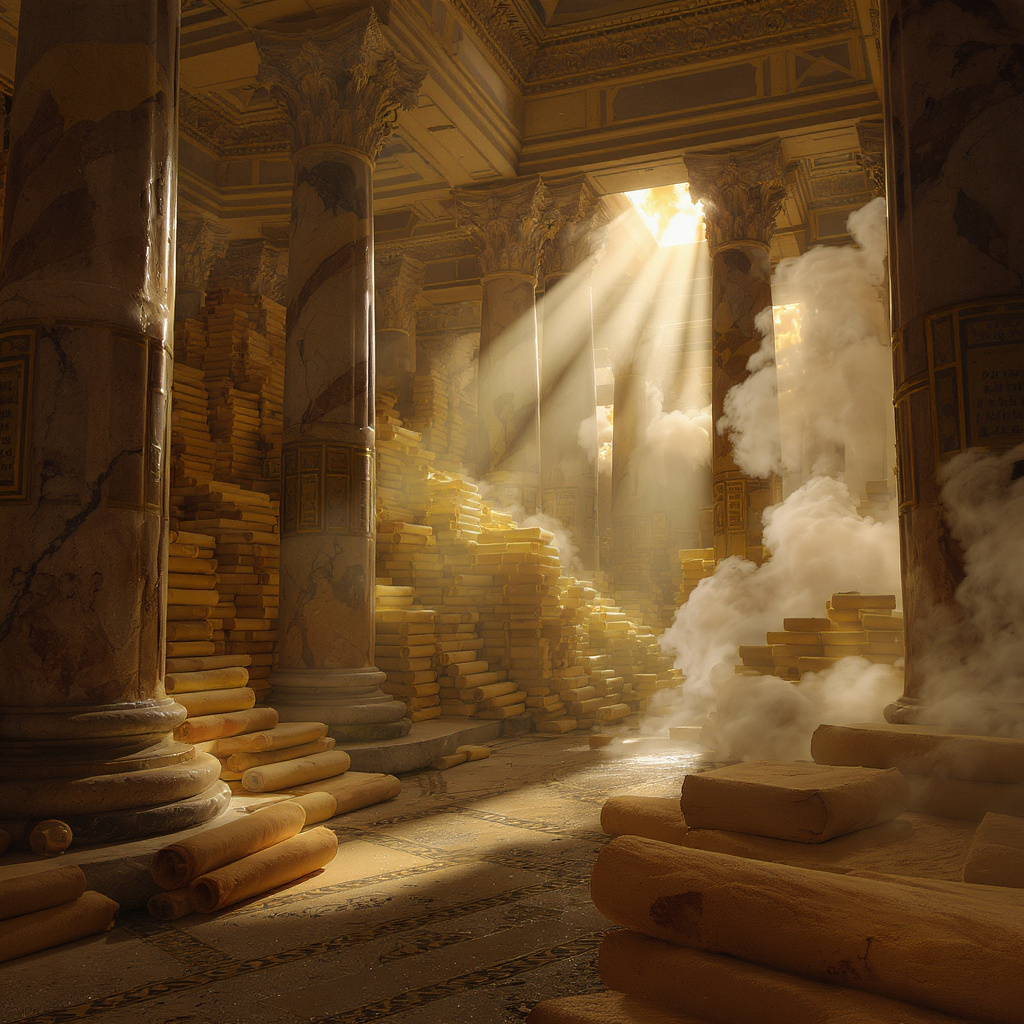
1. When Curiosity Became a Project
More than 2,300 years ago, in the thriving Egyptian port city of Alexandria, a king named Ptolemy I Soter envisioned a structure that would immortalize knowledge itself.
His dream? To build a library that would gather everything ever written — philosophy, mathematics, poetry, astronomy, medicine, even ship logs.
It wasn’t a building — it was an audacious project plan.
A global initiative to centralize wisdom in an age before centralization existed.
The Great Library became a magnet for scholars — Euclid, Archimedes, and Eratosthenes all walked its halls.
But the same unbounded vision that made it legendary also made it vulnerable.
2. The Vision Without Boundaries
If the Library had a Project Charter, it would have been one line long:
“Collect all knowledge under one roof.”
Beautiful. But also — impossible.
There was no scope boundary — no definition of “what kind of knowledge,” “how much,” “to what end,” or “for whom.”
It was the world’s first case of scope bloat — centuries before the term existed.
Every manuscript became a deliverable.
Every idea became a new sub-project.
And like every modern project without limits, the team eventually drowned in its own expansion.
3. Scope Creep: The Silent Fire Before the Flames
The Great Library’s downfall wasn’t just caused by literal fire — it was burned long before that by the flames of overreach.
- Uncontrolled Growth: Every ship entering Alexandria’s harbor was required to hand over its manuscripts for copying — a process that became unmanageable.
- Undefined Ownership: Was it the King’s library, the scholars’ library, or the city’s? No one truly knew who was accountable.
- No Completion Criteria: What did “success” mean? More scrolls? Better catalogues? Greater fame? There was no endpoint.
The Library’s scope grew like wildfire — consuming resources, labor, and clarity until nothing stable remained to protect it.
4. The Cost of “Everything”
We often romanticize ambition.
But unchecked ambition can cost more than failure — it can erase legacy.
When Julius Caesar’s civil war reached Egypt, parts of the Library were set ablaze. Later, rival rulers neglected it, and invading armies ignored its value.
Without governance or continuity, the dream of “all knowledge” crumbled.
In the end, the Library didn’t just lose books — it lost purpose.
That’s the hidden cost of undefined scope — not budget, not time, but meaning.
5. What Modern Project Managers Can Learn
The parallels to today’s world are startling.
💼 Lesson 1: Scope Defines Survival
A project can survive delays and budget overruns. It cannot survive ambiguity.
Define boundaries clearly — what’s in, what’s out, and why.
🧭 Lesson 2: Curate, Don’t Accumulate
The Library tried to collect everything instead of curating what mattered.
Modern PMs should resist the “data hoarding” instinct — focus on relevance, not volume.
⚖️ Lesson 3: Establish Governance Early
No project lasts long without accountability.
Define roles and ownership before execution, not after chaos sets in.
🔥 Lesson 4: Beware of Vision Drift
Projects often start with noble intent and end as beasts of bureaucracy.
Revisit scope regularly — recalibrate goals before expansion becomes entropy.
🪔 Lesson 5: Protect Knowledge with Sustainability
A project’s legacy isn’t its output — it’s its endurance.
The Library of Alexandria didn’t fail because of a single event; it failed because it wasn’t built to sustain uncertainty.
6. The Modern Echo — Digital Alexandria
Today, we have a new Alexandria — the Internet.
Once again, humanity is trying to “contain all knowledge.”
And once again, we face the same questions:
- What’s worth preserving?
- Who decides what’s credible?
- How do we prevent informational overload from turning into digital burnout?
The modern “scope creep” of the Internet age is cognitive — our attention has become the currency under siege.
History’s lesson remains clear: the pursuit of everything often ends with nothing preserved.
7. The Burning Truth
When the Great Library finally burned, it wasn’t just scrolls that disappeared — it was centuries of progress.
Lost were treatises on astronomy, medicine, and philosophy that could have advanced human civilization by centuries.
But maybe, the Library’s greatest contribution wasn’t what it stored — it was the warning it left behind.
That unbounded ambition, however noble, is still fire.
Without scope, it consumes.
With scope, it illuminates.
8. Closing Reflection
If the Great Library of Alexandria were a modern project, it would probably have been funded by global consortia, run with endless expansions, and crash under its own complexity.
And that’s exactly why its story matters.
Because in every era, the difference between brilliance and burnout is the same — the courage to define limits.
So as modern project managers, entrepreneurs, and leaders — let’s take Alexandria not as tragedy, but as testament.
✨ Boundaries do not limit greatness; they preserve it. ✨
Leave a Reply
You must be logged in to post a comment.