
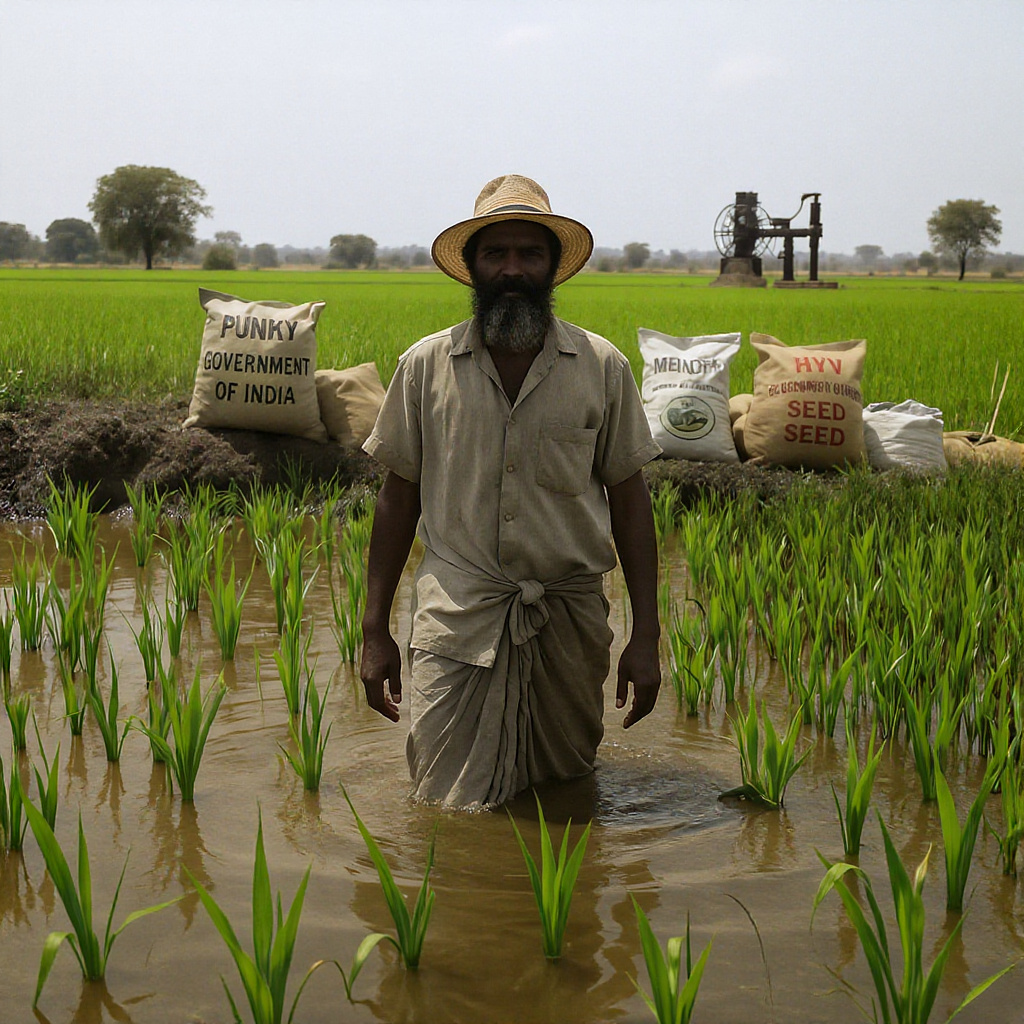
1. A Nation on the Brink: The Project Nobody Could Afford to Fail
In 1965, India faced a severe food crisis.
The country was importing grains under the U.S. PL-480 program — a dependency that threatened political autonomy. Monsoons failed. Rural poverty deepened.
The government, led by Prime Minister Lal Bahadur Shastri and later Indira Gandhi, made a historic commitment: self-sufficiency in food production within a decade.
But the challenge was more than agricultural — it was a resource crisis:
- Land fragmented and overused.
- Farmers undertrained and under-equipped.
- Financial systems weak and inaccessible.
- Global aid conditional and unpredictable.
This is where Project Resource Management principles found their real-world test.
2. The Resource Framework: Turning Chaos into Capability
The Green Revolution wasn’t born in one ministry or lab. It was a multi-sector project, blending agriculture, finance, education, and international collaboration.
The strategy: Identify, Mobilize, and Integrate.
Let’s unpack that framework 👇
A. Identify – Pinpoint which resources were truly scarce (knowledge, not land).
B. Mobilize – Retrain farmers, redirect budgets, repurpose irrigation plans.
C. Integrate – Link all actors — scientists, farmers, bankers, and bureaucrats — into one ecosystem.
That’s textbook Project Resource Management — decades before PMI formalized it.
3. Human Resources: Knowledge as the True Capital
No tractors, no drones, no AI — the biggest resource was human wisdom.
The government built agricultural universities (PAU in Punjab, GBPUAT in Pantnagar) to act as knowledge hubs.
Key initiatives:
- “Farmer Field Schools” where scientists trained cultivators on the ground.
- Deployment of Krishi Vigyan Kendras (agriculture knowledge centers) across rural India.
- Recruitment of young graduates who became field-level change agents.
It was the largest human capital mobilization project in Indian history — and arguably, its most successful.
4. Natural Resources: Engineering the Environment for Abundance
The revolution’s success relied on water. Irrigation canals, tube wells, and dam projects were accelerated at record pace.
This integration between civil engineers and agronomists created a hydrological backbone for sustained growth.
Key outcomes:
- 45 million hectares brought under irrigation within a decade.
- Drought-prone regions converted to stable production zones.
- Groundwater management models evolved for the first time.
This was natural resource optimization — aligning environment and infrastructure toward a single goal: yield.
5. Technological Resources: From Labs to Land
Technology didn’t mean automation — it meant adaptation.
Borlaug’s high-yield wheat varieties were tested for Indian soil.
Scientists cross-bred crops to withstand pests and monsoon cycles.
Seed distribution systems were designed as supply chains, not ad-hoc giveaways.
The process involved a massive resource distribution map — deciding where each technology (seed, fertilizer, equipment) would create the most impact.
It was the first time data-driven agriculture was implemented at national scale — long before data analytics existed.
6. Financial Resources: Designing a Safety Net Around Innovation
Innovation is expensive.
The Indian government understood that without financial de-risking, farmers wouldn’t adopt new methods.
So they built a tri-layered structure:
- Subsidies to offset fertilizer and irrigation costs.
- Minimum Support Prices (MSPs) to guarantee income stability.
- Cooperative Banks to ensure access to credit.
This network made experimentation possible.
It was financial resource management with empathy — using economics as a behavioral nudge toward modernization.
7. International Resources: Collaboration Without Colonization
Unlike earlier development aid models, India insisted on partnership over dependency.
Norman Borlaug’s team and U.S. universities were welcomed — but Indian scientists owned the implementation.
This created a unique integrated resource ecosystem:
- The West brought research and funding.
- India provided adaptation and execution.
- Local farmers became the testing ground for innovation.
It was an early prototype of what we now call co-innovation or public-private partnerships.
8. Resource Risks and Lessons Learned
No project is flawless.
The Green Revolution brought side effects — soil degradation, groundwater depletion, regional imbalance.
But in project management terms, these were resource risks that later evolved into sustainability goals.
Key learnings:
- Over-reliance on a single resource (water, fertilizer) can destabilize systems.
- Resource management must evolve from optimization to regeneration.
- Human resource empowerment must accompany technological change.
9. The Legacy: From Crisis to Competence
By the late 1970s, India had doubled its wheat and rice production.
Famine became history. Rural income rose. A new scientific temperament took root.
But perhaps the greatest legacy was this:
India learned how to plan, mobilize, and synchronize vast resources under a single mission.
That’s not just agriculture — that’s Project Resource Management in its purest form.
10. Lessons for Modern Project Managers
- People before Process.
Tools can’t substitute local intelligence. Empower your human network first. - Context is a Resource.
What works in one region may fail in another — local conditions matter. - Finance Is Strategy.
Budgeting isn’t cost control — it’s behavior design. - Integrate, Don’t Impose.
Collaboration beats compliance in long-term sustainability. - Adapt or Perish.
Resource environments evolve — projects must too.
11. From Green Revolution to Digital Revolution
The same principles now apply to tech and AI ecosystems — aligning data, talent, and funding to create systemic transformation.
The Green Revolution didn’t just grow crops; it grew capabilities.
It taught India how to run complex, cross-disciplinary programs — lessons that still power its space, IT, and manufacturing sectors today.
Leave a Reply
You must be logged in to post a comment.