
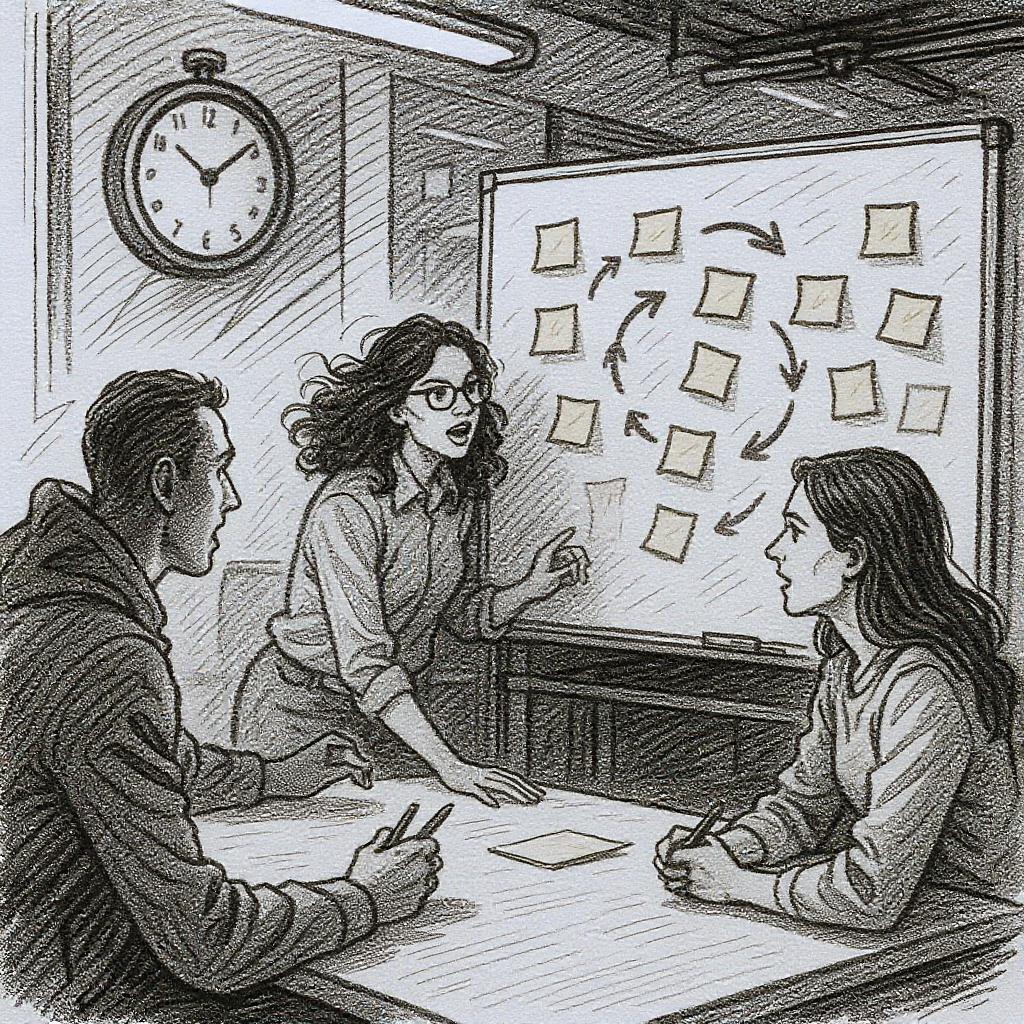
I remember my first brush with Agile like it was yesterday. It was 2015, and I was knee-deep in a software project for a financial firm. Our traditional approach felt like pushing a boulder uphill—every change request meant starting over. Then, a colleague introduced me to the Agile Manifesto. “Individuals and interactions over processes and tools,” it said. That flipped a switch. Today, let’s explore Agile through stories, a corporate case study, and some interactive elements to keep things lively. No dry lectures here—just real talk from the trenches.
The Agile Mindset: More Than Just Sprints and Scrum
Agile is about embracing uncertainty. It’s not a set of rules but a philosophy that values customer collaboration and responding to change. In my experience, shifting to Agile means ditching the “plan everything” mentality for “adapt as you go.”
Key pillars of the Agile mindset:
- Customer focus: Prioritize what users really need, not what you think they do.
- Iterative progress: Build in small increments to test and refine.
- Collaboration over silos: Teams work together, breaking down barriers.
- Continuous improvement: Retrospectives help you get better each time.
- Simplicity is key: Do what’s necessary, not what’s fancy.
- Sustainable pace: Avoid burnout by maintaining a steady rhythm.
Think of Agile like jazz music—structured enough to hold together, but flexible for improvisation.
Case Study: Turning Around a Failing E-Commerce Platform
Let’s get real with a story from 2022. I consulted for an e-commerce company in Delhi struggling with their platform upgrade. They were using Waterfall, and delays were piling up due to shifting market demands—like integrating AI recommendations amid rising competition from giants like Amazon.
- The problem setup:
- Fixed scope led to outdated features by launch.
- Team frustration from constant rework without input.
- Budget overruns hit 30% due to unforeseen changes.
- Customer feedback was ignored until too late.
- Leadership micromanaged, stifling creativity.
- Switching to Agile:
- We adopted Scrum: 2-week sprints, daily stand-ups (15 mins max).
- Product backlog prioritized with MoSCoW method (Must-have, Should-have, etc.).
- Cross-functional teams: devs, designers, and business folks in one room.
- Tools like Jira for tracking, Trello for visuals.
- First sprint focused on MVP—core checkout flow.
- Outcomes and wins:
- Delivered working increments every sprint, gaining quick feedback.
- Reduced time-to-market by 40%.
- Team engagement soared—retros led to process tweaks like pair programming.
- Adapted to a sudden trend: Added voice search after user tests.
- Final launch: On budget, with 25% higher user satisfaction scores.
This case shows Agile isn’t magic—it’s disciplined flexibility. Draw from history: The Agile Manifesto was born in 2001 from software devs tired of bureaucracy, inspired by lean manufacturing from Toyota in the 1950s.
Agile in Action: Tools and Techniques I’ve Sworn By
Over the years, I’ve tested tons of Agile practices. Here’s my curated list, with tips from projects across industries like tech and healthcare.
- Scrum Framework Basics
- Roles: Product Owner (prioritizes), Scrum Master (facilitates), Team (delivers).
- Artifacts: Backlog, sprint board, burndown charts.
- Events: Sprint planning, review, retrospective.
- Tip: Keep stand-ups snappy—what did you do, what will you do, blockers?
- In a healthcare app project, this cut deployment time from months to weeks.
- Kanban for Visual Flow
- Boards with columns: To Do, In Progress, Done.
- Limit WIP (Work In Progress) to avoid overload.
- Pull system: Team pulls tasks when ready.
- Great for ongoing work, like maintenance projects.
- Example: Used it for a content management system; visualized bottlenecks instantly.
- User Stories and Acceptance Criteria
- Format: “As a [user], I want [feature] so that [benefit].”
- Add criteria: Conditions for “done.”
- Involves INVEST: Independent, Negotiable, etc.
- Pro tip: Workshop with stakeholders to write them.
- Helped in a fintech project to align on security features.
- Retrospectives: The Heart of Improvement
- Formats: Start/Stop/Continue, or Mad/Sad/Glad.
- Anonymous input for honesty.
- Action items with owners and deadlines.
- Do them every sprint, even if things go well.
- Turned a rocky team dynamic around in a remote project.
- Scaling Agile: SAFe or LeSS?
- For big orgs: SAFe adds layers like program increments.
- LeSS keeps it simple for multiple teams.
- Choose based on size—SAFe for enterprises.
- In a multinational corp, SAFe synced 10 teams seamlessly.
- Watch for bureaucracy creep; keep it lean.
A Fun Quiz: Test Your Agile IQ!
Ready to play? Here’s a quick quiz based on common Agile scenarios. Grab a coffee and think it through—answers at the end.
- Your team hits a roadblock mid-sprint. What do you do?
- A) Extend the sprint.
- B) Discuss in daily stand-up and adjust.
- C) Ignore and push through.
- What’s the ideal sprint length?
- A) 1 month.
- B) 1-4 weeks, based on project.
- C) As long as needed.
- Scope changes come in—how to handle?
- A) Add to current sprint.
- B) Backlog it for next prioritization.
- C) Reject outright.
- Retros are boring—spice them up?
- A) Skip them.
- B) Use games or themes.
- C) Make them longer.
- Agile vs. Waterfall: When to choose Agile?
- A) For predictable projects.
- B) When requirements evolve.
- C) Always.
Answers: 1-B, 2-B, 3-B, 4-B, 5-B. How’d you score? Share on LinkedIn—let’s compare notes!
Blending Agile with Current Affairs: Lessons from Tech Giants
Look at recent news: In 2025, companies like Tesla are using Agile for rapid EV software updates. Elon Musk’s “fail fast” ethos? Pure Agile. Or take the COVID-19 vaccine rollout—Agile principles helped pharma firms iterate on trials amid uncertainties.
Real-life ties:
- History nod: Agile echoes the Manhattan Project’s adaptive teams in WWII.
- Future gaze: With AI boom, Agile will integrate with DevOps for CI/CD pipelines.
- Industry spin: In construction, “Agile construction” uses modular builds.
- Challenges: Hybrid models for regulated fields like banking.
- Personal anecdote: During a 2023 merger project, Agile helped navigate cultural clashes.
Agile adapts to the times—it’s timeless yet timely.
Self-Help Guide: Adopting Agile in Your Daily Work
Not leading a team? Agile works for personal projects too. Here’s a guide to infuse Agile into your routine.
- Set personal sprints: Weekly goals, review Fridays.
- Daily stand-up: Morning journal—what’s today’s focus?
- Backlog your tasks: Use apps like Todoist.
- Retrospect weekly: What worked, what didn’t?
- Adapt to life changes: Family event? Reprioritize.
- Measure progress: Burndown your to-do list.
I use this for my consulting gigs—keeps me sharp and balanced.
Critiquing Agile: When It Falls Flat and How to Fix It
Agile isn’t perfect. I’ve seen it flop when teams “do Agile” without “being Agile.” Critiques: Too many meetings, lack of documentation, or “Agilefall” hybrids that dilute benefits.
Fixes from experience:
- Over-meeting syndrome: Time-box everything strictly.
- Documentation drought: Use “just enough” docs, like wikis.
- Resistance to change: Train and coach patiently.
- Scaling pains: Pilot small before going big.
- Metric madness: Focus on value, not velocity alone.
In a 2024 project, we critiqued our setup mid-way and pivoted—saved the day.
Leave a Reply
You must be logged in to post a comment.