
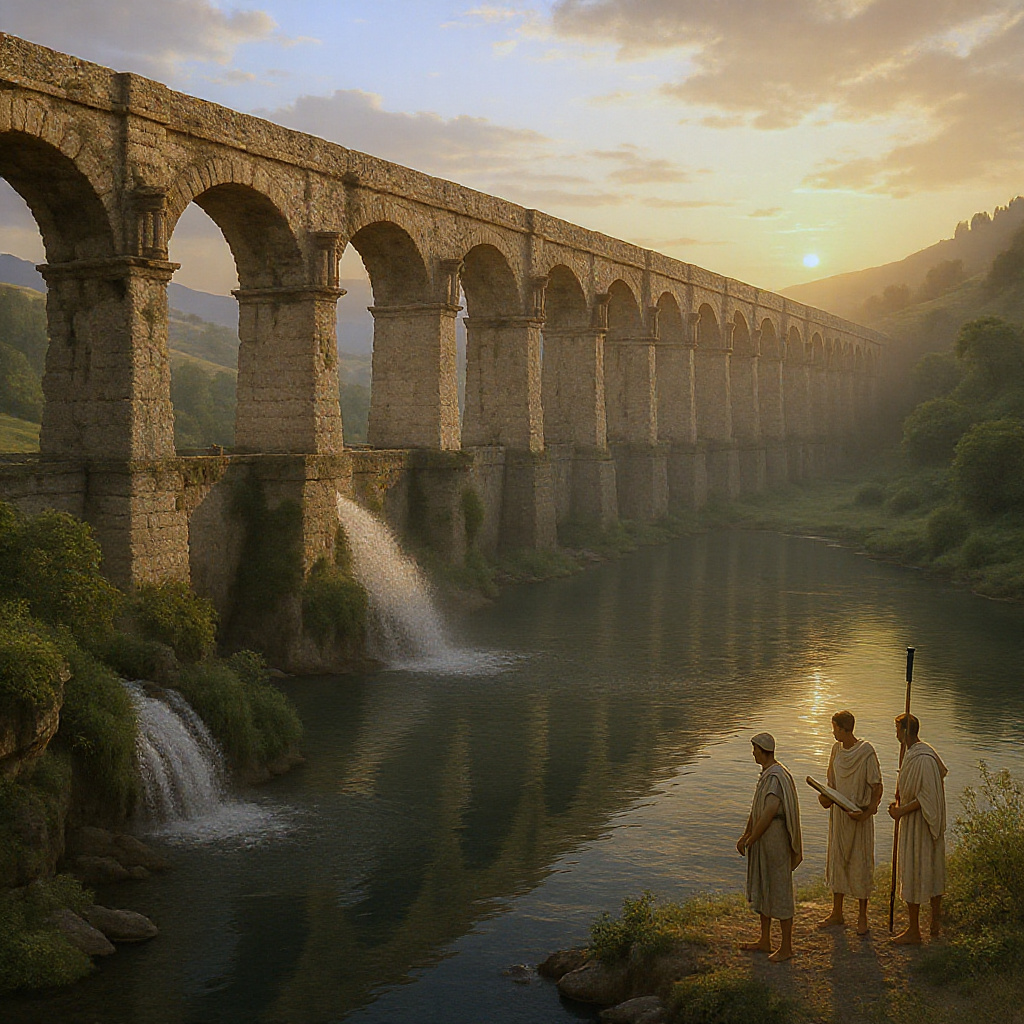
1. Rome: The City That Engineered Its Future
When the Roman Empire decided to build aqueducts, it wasn’t about vanity — it was about quality of life.
Water meant sanitation, agriculture, and public health. By ensuring water reached every household, Rome made quality an expectation, not a privilege.
Their quality philosophy was simple:
“If it cannot last, it is not Roman.”
That belief became their foundation for Project Quality Management, centuries before PMBOK gave it a name.
2. Quality as a System, Not a Step
The Romans didn’t check for quality after construction — they designed for it.
Their aqueducts had:
- Precision Gradients: Only a few centimeters of fall per kilometer — ensuring stable flow without turbulence.
- Gravity-Driven Systems: No reliance on mechanical energy — reducing maintenance risks.
- Self-Cleaning Channels: Built with slight curvature to allow sediments to flush naturally.
Every design decision reflected an understanding of lifecycle quality — ensuring performance decades after completion.
3. Materials That Stood the Test of Time
Their secret weapon was pozzolanic concrete — a material that reacted chemically with water, creating self-healing structures.
Today’s engineers still study this ancient formula. In fact, modern research at MIT found that Roman concrete can “reabsorb” carbon dioxide and self-repair cracks over time — a sustainability goal we’re only now rediscovering.
For project managers, this teaches a timeless truth:
The best quality systems are those that sustain themselves.
4. Governance and Accountability: Early QA Frameworks
Rome had a clear hierarchy for quality assurance:
- Curator Aquarum: A senior official overseeing water systems — like a modern QA director.
- Architecti and Mensores: Engineers and surveyors who tested and calibrated gradients.
- Public Inspectors: Citizens empowered to report leaks or blockages.
This layered accountability created what we’d call today a multi-level quality governance framework.
They didn’t rely on one person to “check quality.” It was a collective responsibility.
5. Testing, Validation, and Prototyping — Ancient Pilot Runs
Before scaling up, the Romans tested smaller segments — studying water behavior, material resilience, and local terrain.
They treated every project as a prototype for the next one.
Key takeaways for modern PMs:
- Validate before scaling.
- Replicate what works.
- Refine continuously.
This approach mirrors modern Agile retrospectives — learn, iterate, improve.
6. Cultural Integration of Quality
Romans didn’t separate engineering from ethics.
To them, poor craftsmanship was a moral failure. Every stone had to fit perfectly because it represented civic duty, not just structural stability.
That deep sense of ownership — the pride of making something eternal — is the real essence of quality.
Quality is not just about precision; it’s about purpose.
7. Maintenance and Continuous Improvement
Once built, aqueducts were regularly inspected and maintained. Teams cleaned channels, repaired erosion, and reinforced arches — ensuring uninterrupted flow.
In effect, they had a preventive maintenance plan centuries before the term existed.
The insight for today:
The cost of quality is always lower than the cost of failure.
Rome’s continuous investment in maintenance allowed its aqueducts to serve for centuries — some still supply water today.
8. The Three Pillars of Vitruvian Quality
Vitruvius’ doctrine — firmitas, utilitas, venustas — remains the gold standard for balanced project quality:
- Strength: The structure must endure.
- Utility: It must serve its purpose efficiently.
- Beauty: It must inspire and elevate.
Modern quality frameworks like ISO 9001, TQM, and Lean mirror these principles — though in corporate jargon rather than marble inscriptions.
9. Lessons for the Modern Project Manager
1️⃣ Quality by Intent: Define quality from the project’s vision, not its checklist.
2️⃣ Design for Longevity: Build processes that self-correct and sustain.
3️⃣ Govern Quality Collectively: Everyone owns the outcome.
4️⃣ Test Early, Scale Wisely: Prototype-driven delivery is timeless wisdom.
5️⃣ Make Pride Your Process: When teams believe in excellence, no inspection is needed.
10. The Legacy of Flow — Quality That Outlives Its Maker
The Roman aqueducts still run.
Their builders are gone, but their principles live on in every bridge, dam, and skyscraper that values durability over deadlines.
They remind us that true project quality isn’t about delivering faster — it’s about delivering forever.
Leave a Reply
You must be logged in to post a comment.