
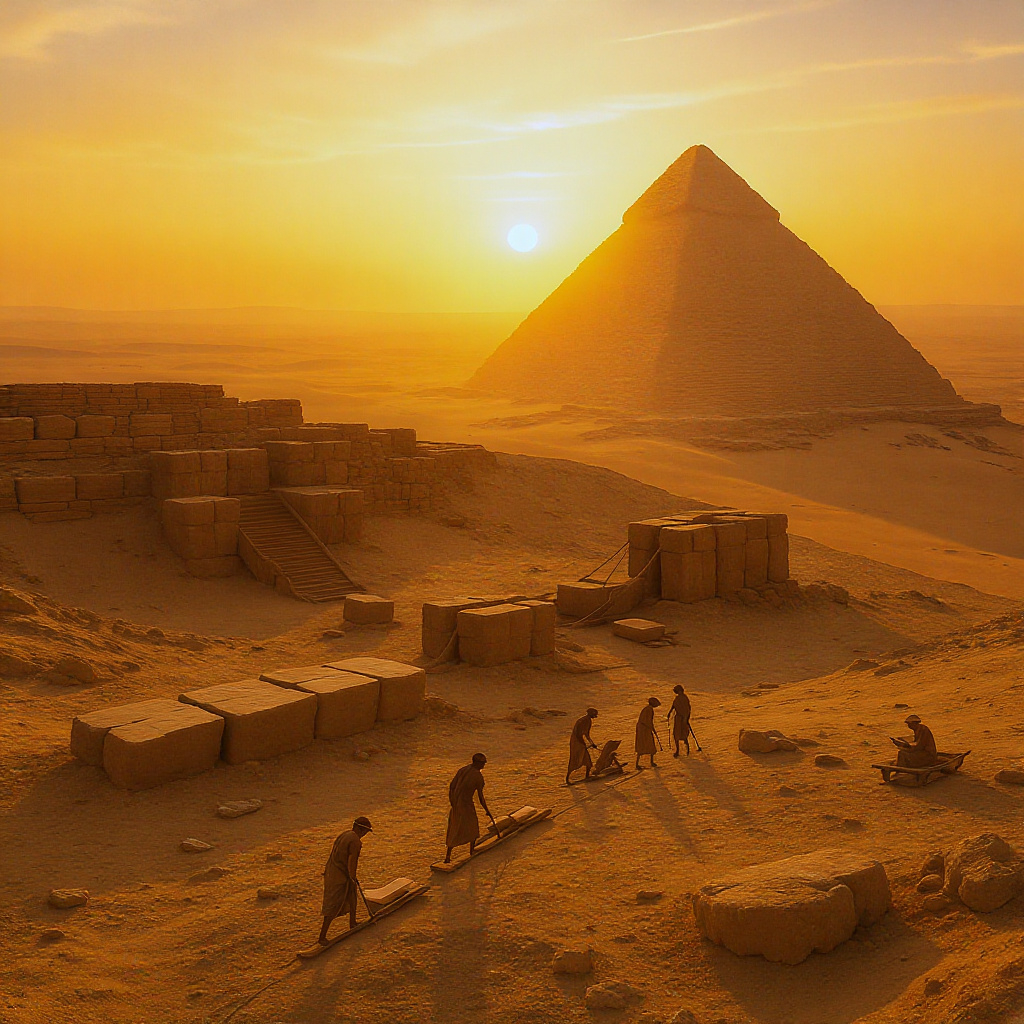
1. Setting the Stage: A Civilization Built on Projects
Ancient Egypt was more than a kingdom — it was a perpetual construction site. Temples, tombs, canals, and cities rose from the desert, each demanding meticulous planning and disciplined execution.
But none rivaled the scale or ambition of the Great Pyramid of Giza — 146 meters tall, perfectly aligned with the stars, composed of 2.3 million stones.
This wasn’t merely architecture. It was project economics — before economics existed.
2. Cost Defined by Value, Not Money
In a world without currency, the Egyptians measured cost through value flow.
- Labor was paid in food rations — beer, bread, onions, and meat.
- Materials were tracked by volume, not price.
- Tools were maintained and recycled, reducing replacement costs.
By defining cost in tangible utility, they avoided the abstraction that plagues many modern projects. Cost wasn’t a spreadsheet entry — it was a living exchange between people and purpose.
3. Material Logistics — Ancient Supply Chain Excellence
Transporting millions of limestone blocks required precision that rivals modern logistics.
- Quarries were identified near Nile banks to optimize water transport.
- Temporary canals were dug for barge movement.
- Ramps and sledges reduced friction, saving both time and resources.
Each stage had clear ownership — foremen, measurers, and recorders. Every delivery was logged on papyrus, a system akin to our procurement reports and delivery dockets.
Their success lay in visibility — everyone involved knew what was being built, by whom, and when. That’s true cost control.
4. Labor Management — The Original Resource Calendar
At its peak, about 20,000–30,000 workers operated on a rotational basis. Teams worked in cycles of 3–4 months, ensuring constant productivity without burnout.
This rotation system acted as cost leveling — balancing effort and expenditure across time.
Teams were organized into units named after pharaohs or gods — a motivational system blending identity with accountability. They didn’t just work; they belonged.
Modern PMs call this “cultural alignment” — the Egyptians had mastered it 4,000 years ago.
5. Schedule and Cost — A Single Currency of Control
The Egyptians understood that time was cost.
Each day’s delay meant extended provisioning — more bread, more beer, more manpower. Hence, their planning integrated both.
Archaeological findings show daily progress markers — tally marks carved in stone to track volume completed.
This was proto–Earned Value Management:
- Planned Work: Targeted stone layers.
- Earned Work: Stones actually placed.
- Variance: Gaps corrected before scaling higher.
They practiced what today’s PMBOK calls Integrated Cost and Schedule Control.
6. Managing Change and Scope Creep — Pharaoh’s Mandate
Unlike modern clients, Pharaohs were uncompromising. Scope creep was not tolerated — once the design was decreed, deviation was heresy.
But this rigidity was also efficiency.
By eliminating mid-project change, the Egyptians achieved precision in planning, procurement, and manpower allocation.
Lesson: sometimes cost control requires clarity of boundaries — not just better tools.
7. Documentation and Audit Trails — The Papyrus Records
Surviving papyri show logs of grain allocations, worker rotations, and material receipts. These were the world’s first cost audit records.
They show cost overruns, substitutions, and performance ratios — a reminder that transparency was vital even in autocratic systems.
Where we have dashboards, they had scrolls — but both served the same truth: you can’t manage what you don’t measure.
8. Cost as Cultural Legacy
The Great Pyramid was completed in about 20 years — within its planned timeframe.
No modern project of equivalent scale and complexity has matched that efficiency.
The reason is simple — for them, cost control wasn’t compliance; it was culture.
They built not for profit, but for posterity. And that purpose drove precision.
9. Lessons for Modern Project Managers
- 1️⃣ Define cost in human terms. Understand what your team values; align cost to motivation.
- 2️⃣ Make visibility your control mechanism. Transparency eliminates waste faster than oversight.
- 3️⃣ Integrate time and cost. Every delay is an expense — treat your schedule as a budget.
- 4️⃣ Protect scope. Clarity is the cheapest project insurance.
- 5️⃣ Measure relentlessly. Ancient Egypt’s papyrus reports were their dashboards — yours should be no less disciplined.
10. The Timeless Equation of Cost and Meaning
The pyramids remind us that cost management isn’t about saving money — it’s about sustaining purpose.
Every cost that builds something eternal is an investment, not an expense.
4,000 years later, project managers still stand in awe of what disciplined resource management — and unwavering vision — can achieve.
Leave a Reply
You must be logged in to post a comment.