
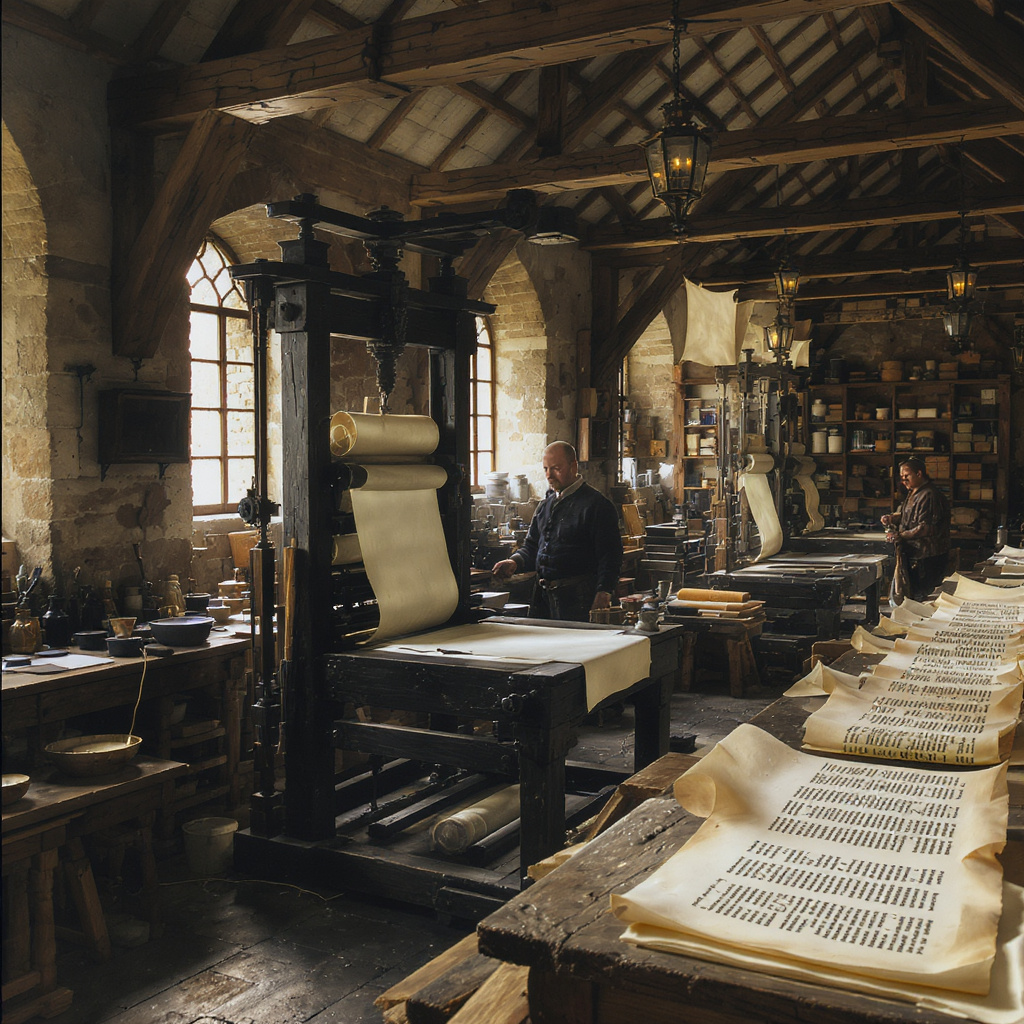
1. The World Before Words Could Travel
In 15th-century Europe, communication was slow, exclusive, and fragile. Books were hand-copied by monks. A single Bible could take years to reproduce. Information belonged to the elite — not the people.
Then came Johannes Gutenberg, a goldsmith with an idea so radical it bordered on heresy — to replicate words the way coins were minted.
It wasn’t just an invention. It was a project of integration, innovation, and communication.
2. The Project Blueprint: A Communication System, Not Just a Machine
Most people think Gutenberg invented the printing press overnight. In truth, it was a decade-long project that combined metal casting, oil-based ink, movable type, and mechanical pressure — all synchronized through a communication strategy that aligned crafts, materials, and manpower.
Every craftsman had a role, every component had a voice, and every iteration communicated learning.
In modern terms, Gutenberg’s workshop was a collaborative communication model — a cross-functional team exchanging ideas without formal reports, driven by shared purpose.
3. Stakeholders, Silence, and Strategic Communication
Gutenberg’s biggest challenge wasn’t technical — it was political.
- He had investors demanding returns.
- Clergy suspicious of mass knowledge.
- Craftsmen guarding trade secrets.
He mastered what today’s PMs call selective communication — knowing what to say, to whom, and when.
He shared progress with financiers through results, not promises; he protected innovation through controlled disclosure.
Sometimes the best communication isn’t broadcasting — it’s managing narrative.
4. The First Project Communication Plan — Without Knowing It
We can reverse-engineer Gutenberg’s success through a modern lens:
- Objective: Democratize information by producing identical, affordable books.
- Channels: Workshop demonstrations, printed prototypes, patron endorsements.
- Stakeholders: Investors, the Church, artisans, scholars, and the public.
- Message: Precision, faith, and permanence.
- Outcome: The Gutenberg Bible — the world’s first mass-produced book, and the birth of scalable communication.
He used visibility (demonstrations), control (confidentiality), and storytelling (the moral value of printing) to maintain alignment and momentum.
5. Failure, Bankruptcy, and the Power of Legacy Communication
Ironically, Gutenberg lost ownership of his own invention due to investor disputes. But his communication outlived him.
The printed word traveled faster than armies, shaping revolutions, reforms, and renaissances.
His story is a reminder that effective project communication isn’t about your career — it’s about your contribution.
If your message builds systems that keep talking after you’re gone, you’ve communicated successfully.
6. Lessons for Modern Project Managers
- 1️⃣ Clarity beats frequency. Don’t send more updates — send more meaning.
- 2️⃣ Communication is architecture. It must hold the project together, not decorate it.
- 3️⃣ Protect your innovation through timing. Not every update deserves an audience.
- 4️⃣ Align people through purpose. Gutenberg’s project wasn’t about printing; it was about access to knowledge.
- 5️⃣ Measure communication by influence, not noise. The Gutenberg Bible didn’t go viral; it went eternal.
7. The Ripple Effect — How One Project Built a Global Communication Ecosystem
Within decades of the press’s invention:
- Scientific journals spread discoveries.
- Reformation leaders challenged dogma.
- Explorers navigated with printed maps.
- Universities multiplied literacy.
Every book, every pamphlet, every newspaper you’ve ever read — traces its lineage to Gutenberg’s original communication plan.
His workshop was humanity’s first PMO for ideas.
8. Communication as the Soul of Every Project
Whether you’re managing a global transformation or a small startup, remember: communication is not a function — it’s the bloodstream of every project.
It carries purpose, alignment, and emotion.
Gutenberg’s legacy teaches us that when we communicate with integrity, precision, and passion — we don’t just deliver messages. We shape history.
Leave a Reply
You must be logged in to post a comment.