
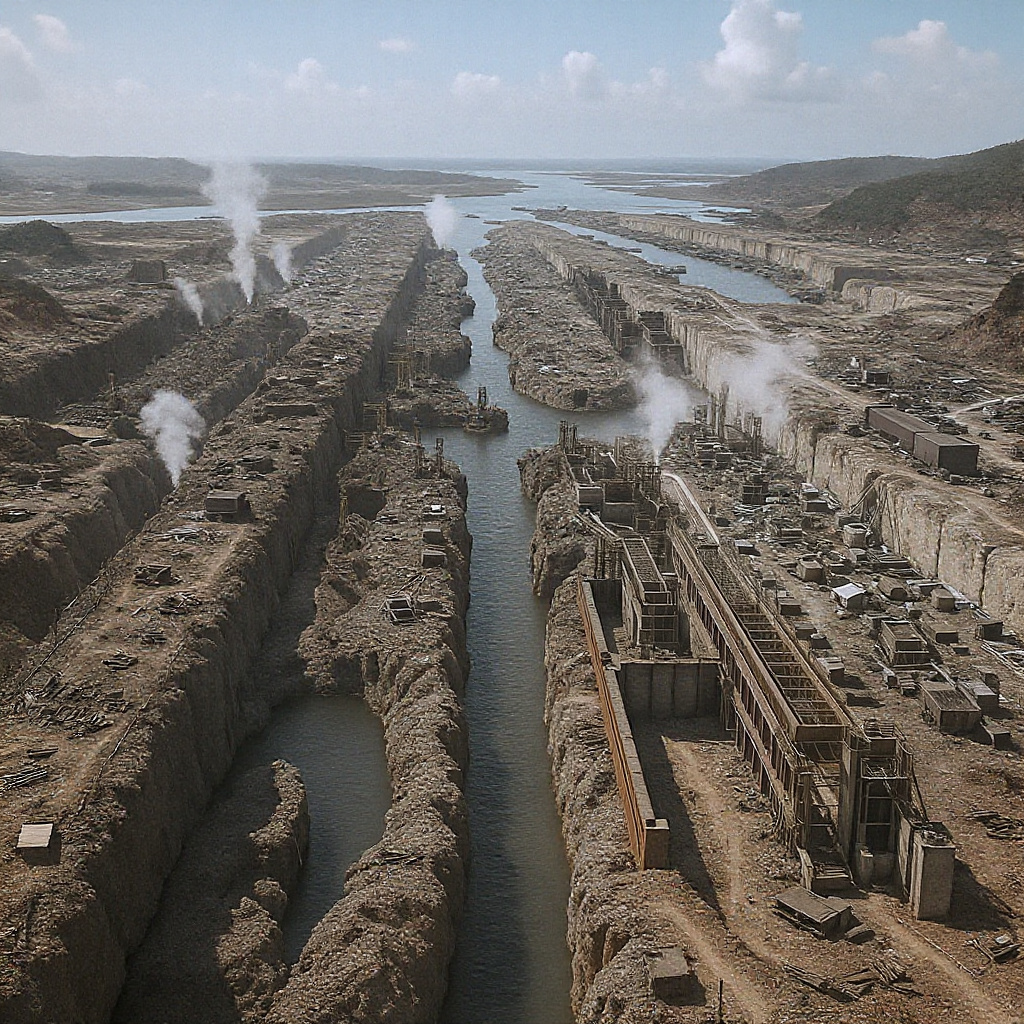
1. The Dream That Drowned in Debt
In the late 19th century, the French were basking in the glory of engineering triumphs. Ferdinand de Lesseps, the celebrated builder of the Suez Canal, had become a national hero. His success in Egypt made him believe he could achieve anything — and so, in 1881, he embarked on his next great vision: carving a waterway through the narrow strip of land connecting the Atlantic and Pacific Oceans.
The idea was seductive: a sea-level canal through Panama, allowing ships to cut weeks off their voyages. The investors cheered, the newspapers sang, and the public poured money into what was branded as “a second Suez.”
But what they didn’t see — or chose to ignore — was that Panama was not Egypt. It was a tropical nightmare of dense jungles, torrential rains, landslides, and deadly diseases.
From day one, the cost estimates were fantasy. Lesseps, driven by pride and public expectation, dismissed engineers who cautioned against a sea-level design. He insisted on his vision, believing “willpower could overcome geography.”
2. When Optimism Becomes Delusion
The first failure of cost management is often emotional, not mathematical.
Lesseps’ team estimated a total cost of 120 million francs. Within three years, it had doubled. Then tripled. Then quadrupled.
But the project continued — funded not by rational investment, but by national pride and collective delusion. Each shortfall was patched by issuing new bonds to the public, each more speculative than the last.
When financial audits began to reveal the scale of the overruns, the leadership resorted to secrecy, hoping to “fix it before the truth got out.” By the time it did, the company was bankrupt. Over 800,000 investors, mostly middle-class citizens, lost everything.
It was the 19th-century version of a mega project meltdown.
3. Anatomy of the Cost Failure – Timeless Lessons
Let’s break down where it all went wrong — because every single failure mirrors the challenges modern project managers face today.
a) Unrealistic Cost Estimation
- The initial projections assumed that Panama’s terrain would be as forgiving as Suez’s desert sands.
- Engineers who warned that geological unpredictability would multiply costs were silenced.
- Today, we see the same pattern in digital transformation projects that underestimate integration complexity.
Lesson: Cost estimation is not a wish list — it’s a negotiation with reality.
b) Political Pressure and Public Image
- Lesseps was not just building a canal; he was defending a national symbol.
- Political leaders and newspapers amplified success and suppressed dissent.
- Admitting cost overruns was seen as unpatriotic.
Lesson: When reputation outweighs realism, cost management turns into propaganda.
c) Scope Creep Disguised as Progress
- Engineers repeatedly warned that a sea-level canal was infeasible. The terrain demanded a lock system.
- Lesseps refused to alter the design until it was too late — by then, most funds were gone.
Lesson: Scope change delayed is cost overrun multiplied.
d) Ignoring Environmental and Health Costs
- Thousands died of malaria and yellow fever — a “hidden cost” never accounted for in budgets.
- Work stoppages, labor shortages, and constant rework eroded finances daily.
Lesson: Environmental and human sustainability are financial parameters, not side notes.
e) Lack of Cost Governance Structure
- The project lacked transparent reporting mechanisms.
- Data was manipulated to maintain investor confidence.
- There was no independent cost review — no PMO, no audits, no accountability.
Lesson: Without transparency, cost data becomes a political instrument, not a control tool.
4. The American Takeover – A Study in Redemption
When the French effort collapsed in 1889, it was considered an unmitigated disaster. But fifteen years later, the United States took over the project, applying lessons from that failure.
They changed everything:
- Adopted the lock canal system instead of the sea-level design.
- Established clear governance and cost controls.
- Conducted detailed feasibility and health studies.
- Introduced regular reporting and phased funding releases.
The result? The canal was completed in 1914 — on a controlled budget and within an adjusted, realistic schedule.
This is perhaps the most dramatic transformation in cost management history: from financial ruin to sustainable execution, simply by replacing ambition with accountability.
5. The Modern Parallel – Why We Still Repeat the Same Mistakes
Despite all the tools, templates, and training, modern projects often repeat the same mistakes as Lesseps did:
- Overconfidence at initiation.
- Political or executive blindness to constraints.
- Disregard for early cost warnings.
- Unrealistic optimism disguised as vision.
Whether it’s the Berlin Airport, Sydney Light Rail, or enterprise digital transformations, the common thread remains: we confuse ambition with inevitability.
Every budget that fails had a warning that was ignored.
6. The Real Essence of Project Cost Management
Cost management is not a financial activity — it’s a psychological discipline.
It’s about asking uncomfortable questions early:
- “What’s the worst-case scenario?”
- “What if the assumptions fail?”
- “Who benefits from hiding the truth?”
The French canal failed because no one dared ask these.
Modern PMOs exist precisely to prevent such blindness — but only if they are empowered to tell the truth.
7. Closing Reflections – The Cost of Overconfidence
When Ferdinand de Lesseps died, he refused to acknowledge the canal’s failure. To him, it was only “unfinished.” But history had already judged — his dream was magnificent, but his cost management was catastrophic.
The Panama Canal stands today not as a monument to failure, but as a cautionary reminder that cost control is not about saving money — it’s about saving credibility.
In every project, there’s a point where optimism must bow to evidence. Lesseps never found that point. We, as project managers, must.
Leave a Reply
You must be logged in to post a comment.