
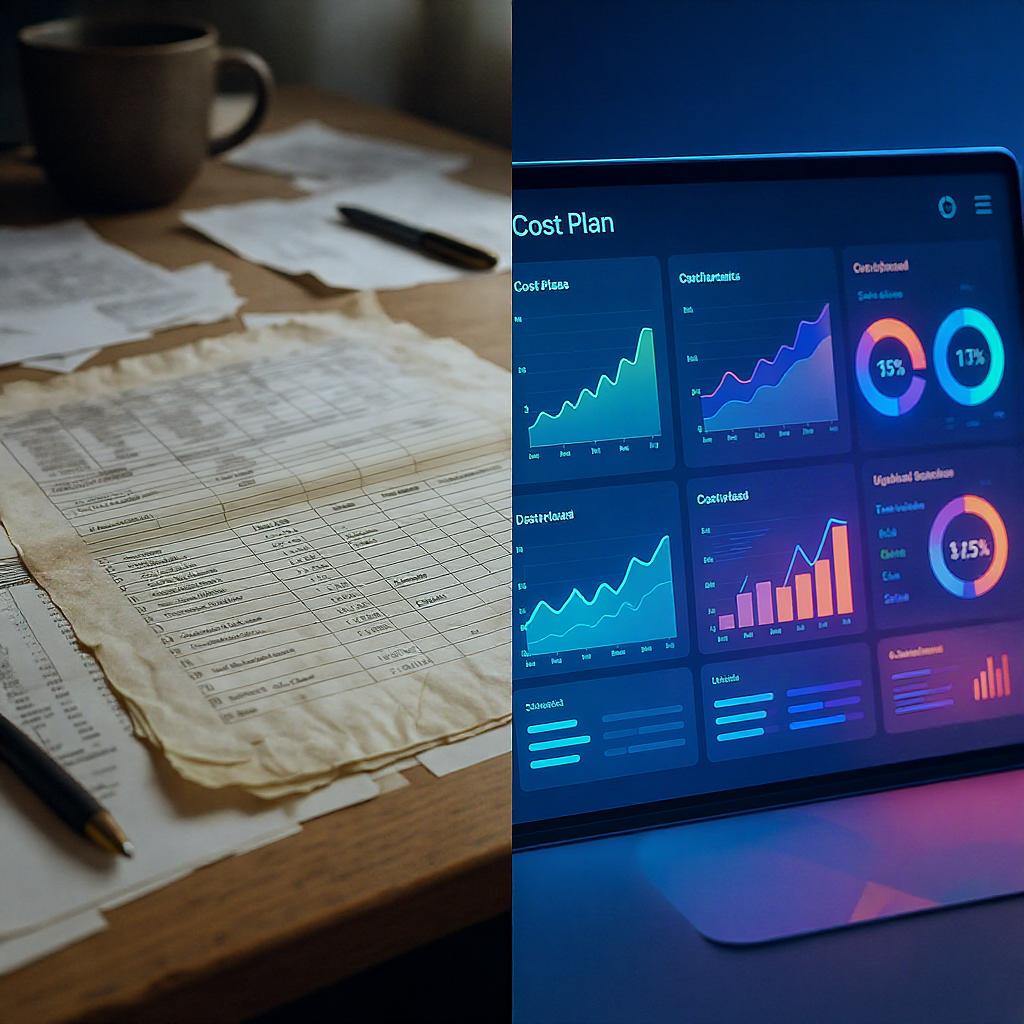
▶️ Introduction – The Budget Is Not the Battlefield. The Forecast Is.
Every project begins with a number. A top line. A bottom line.
And a confident promise: “We’ve got this covered.”
But confidence fades when actuals start piling up against projections.
The truth? Most projects don’t fail due to the original budget—they fail because of what happens after.
This article unpacks how project cost management has evolved—and how successful teams think beyond spreadsheets.
1️⃣ What Went Wrong Before: Planning Without Adaptability
- Annual or One-Time Cost Plans
- Created during initiation, rarely revisited unless crisis struck.
- Locked down with no flexibility for minor shifts.
- Manual Tracking with Time Lags
- Finance and PM teams updated actuals monthly—by then, overruns had snowballed.
- No early warning system.
- Scope Ignored Budget Impact
- New features? Design changes? Scope additions? Budget remained untouched.
- No linkage between change control and cost forecasting.
- No Earned Value Metrics
- Teams tracked hours spent and money spent—but not value earned.
- Missed opportunity to measure productivity and value delivery.
2️⃣ How Teams Forecast Cost Differently Today
- Rolling Forecasts Instead of Static Budgets
- Monthly or bi-weekly updates to cost projections based on burn and progress.
- Earned Value Management (EVM)
- Use of metrics like:
- CPI (Cost Performance Index)
- SPI (Schedule Performance Index)
- ETC (Estimate to Complete)
- EAC (Estimate at Completion)
- Use of metrics like:
- Scope-to-Cost Linking
- Integrated tools that connect backlog or change requests with cost implications.
- Dashboards with Predictive Analytics
- Visual alerts when trends deviate—before damage is done.
- Collaborative Accountability
- Every team lead understands their cost impact—not just Finance.
3️⃣ 5 Cost Management Traps That Still Haunt Projects
- “We Can Absorb This Minor Change” Mentality
- Death by a thousand cuts. Small changes add up—fast.
- Underestimating Complexity
- The classic trap: “This feature will only take 2 days.” Add 0.5x for testing, integration, coordination.
- Treating Budget as a Reporting Metric
- If you only care about budget at review meetings—you’re already late.
- Ignoring the Burn Rate
- Look at how fast the money is going—especially mid-sprint.
- No “What-If” Scenarios
- Good plans have contingency buffers. Great ones simulate risks.
4️⃣ Real-World Case Studies
⚠️ Project Mirage (2017 – Telecom Network Expansion)
- Initial cost plan: $14.3M
- Scope changes were handled by “absorbing effort”
- No EVM metrics used
- Final spend: $19.8M
- Overspend discovered after vendors were paid
✅ Project Athena (2023 – eLearning Platform Revamp)
- Rolling forecasts reviewed biweekly
- CPI tracked throughout: maintained at 0.97–1.04
- Change requests tied to sprint-level budget deltas
- Final delivery: 4% under budget, 2 weeks early
🎯 Lesson: Real-time forecasting isn’t an expense—it’s protection.
5️⃣ Self-Audit: Your Cost Maturity Scorecard
| Statement | Yes | No |
|---|---|---|
| We update cost forecasts more than once per month | ☐ | ☐ |
| Cost variances trigger action, not just reporting | ☐ | ☐ |
| Our scope and change log are integrated with budget impact | ☐ | ☐ |
| Team leads know how their actions impact CPI/SPI | ☐ | ☐ |
| Our dashboards highlight EAC and ETC in real time | ☐ | ☐ |
👉 If you scored 3 or less → Your cost control may be reactive instead of strategic.
6️⃣ Templates & Tools to Modernize Cost Management
- Rolling Forecast Sheet (Excel + Google Sheets)
- Auto-calculates ETC/EAC based on % complete and burn rate.
- Change Request Cost Evaluator
- Quick calculator that attaches cost delta to scope tickets.
- EVM Dashboard
- Color-coded CPI/SPI tracking with trendlines and warnings.
- Weekly Cost Impact Canvas
- Helps teams visualize their impact beyond time—into actual money.
➡️ Practical Steps to Build Forecast Muscle
- Educate Teams on EVM
- Make CPI and SPI as common as burnup and velocity.
- Connect Cost with Value
- Track not just what’s spent—but what’s gained.
- Visualize Early Warnings
- Red/yellow/green dashboards beat red flags in review meetings.
- Update Forecasts Proactively
- Schedule forecasting reviews before major milestones.
- Make Cost Part of Every Sprint Review
- Celebrate budget-positive decisions just like feature releases.
🔚 Conclusion: Managing Cost Means Managing Change
Project cost management isn’t just about numbers.
It’s about narratives. Every dollar spent tells a story—of risk taken, value earned, or mistakes made.
Modern PMs don’t fear the budget—they shape it, evolve it, and own it.
💸 Because the goal isn’t to underspend—it’s to spend smartly.
Leave a Reply
You must be logged in to post a comment.