
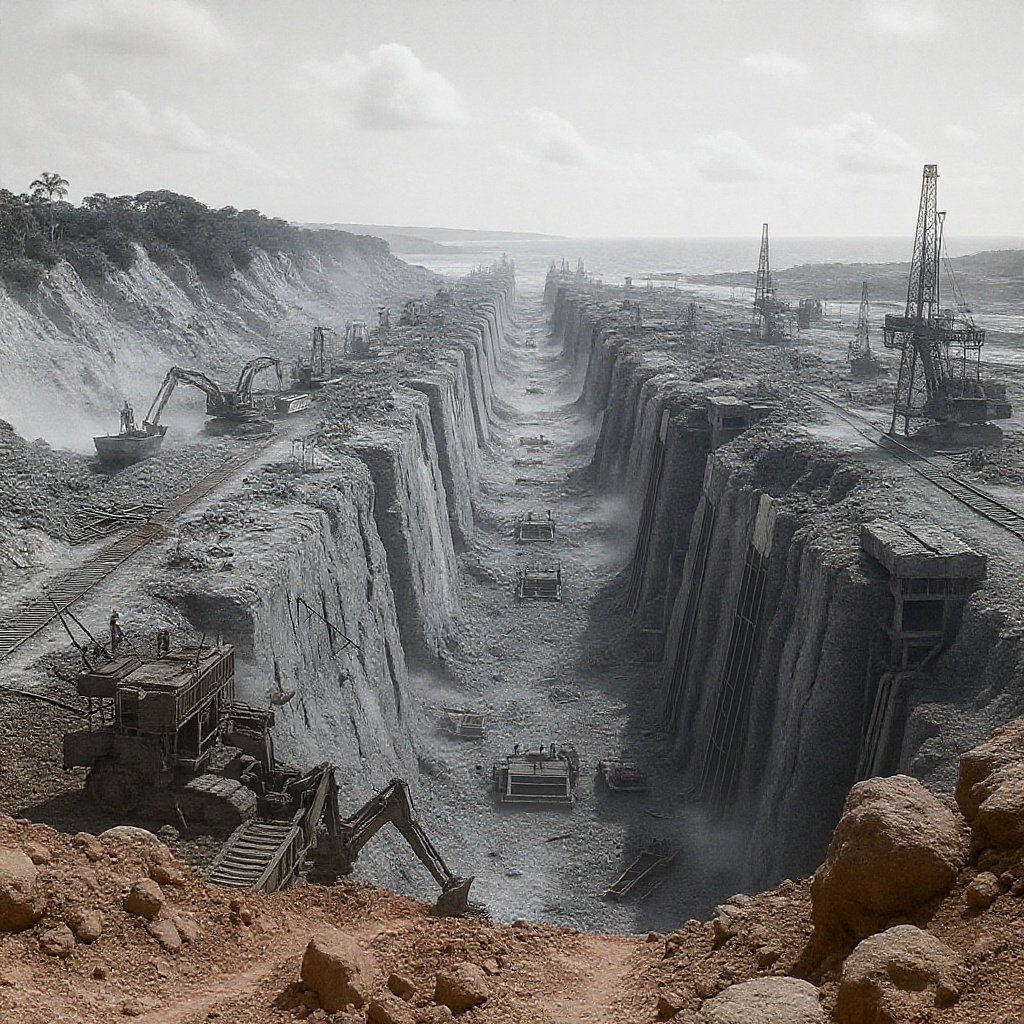
1. The Dream That Sank in Debt
In the late 19th century, the world was obsessed with conquering geography. Connecting the Atlantic and Pacific Oceans through Central America promised global dominance — politically, commercially, and militarily.
The French, led by Ferdinand de Lesseps, began construction in 1881. Flush with the success of the Suez Canal, de Lesseps believed that Panama could be conquered by the same design — a sea-level canal.
He couldn’t have been more wrong.
The tropical terrain was unstable. Rainfall was relentless. Mosquito-borne diseases like malaria and yellow fever decimated workers. The equipment rusted, the logistics crumbled, and morale plummeted.
By 1889, the French company had gone bankrupt. Over $300 million (in 19th-century value) had vanished — a catastrophic cost failure that rocked global investors.
Lesson: Assumption is the most expensive line item in any project.
2. The American Takeover – Rebuilding the Budget and the Dream
In 1904, the United States purchased the failed French project for $40 million — not just to build a canal, but to prove that disciplined cost management could turn chaos into control.
President Theodore Roosevelt appointed John Stevens, an experienced railroad engineer, to lead the revival. Stevens approached the canal not as a construction site but as a system of interdependent costs.
a) Design Optimization: Locks Over Sea Level
- A sea-level canal required excavation of over 120 million cubic meters of earth — economically unfeasible.
- Stevens proposed a lock-based system, using reservoirs to raise and lower ships — drastically reducing both cost and time.
- This pivot alone saved what would today amount to billions of dollars.
Lesson: Good design decisions are the purest form of cost control.
b) Cost of Human Life – The Hidden Ledger
The Americans realized that no cost plan could succeed without addressing the health of workers.
Chief sanitation officer Dr. William Gorgas implemented massive public health programs — fumigating swamps, draining stagnant water, and distributing quinine to fight malaria.
By improving living conditions, workforce stability rose — and so did productivity.
Lesson: Every sick day is a cost line. Every human risk ignored becomes a financial crisis.
c) Phased Budgeting and Accountability
Unlike the French, the U.S. introduced phased budgets — dividing the project into measurable milestones with defined cost targets.
Each phase was monitored by on-site cost controllers and engineers who tracked real-time expenses, resource usage, and output.
Lesson: You can’t control what you can’t measure — and you can’t measure what you don’t segment.
3. Politics and Cost Control – The Invisible Project Manager
Behind the engineering triumph was the political architecture of cost management.
The U.S. Congress demanded regular updates, transparent spending reports, and justification for every appropriation. Public scrutiny became a forcing function for fiscal discipline.
Roosevelt famously said:
“The credit belongs to the man who is actually in the arena.”
But the truth was — the arena was built by accountants, controllers, and budget analysts who ensured every dollar spent had a purpose.
Lesson: Governance is not bureaucracy — it’s fiscal protection.
4. The Balancing Act – Cost, Schedule, and Scope
The canal’s success lay in achieving balance — not perfection.
Project managers constantly had to negotiate between:
- Excavation progress vs. safety risk.
- Workforce expansion vs. accommodation costs.
- Equipment procurement vs. maintenance budgets.
Instead of chasing the “ideal” plan, they adapted dynamically. Cost became not a constraint — but a conversation between competing priorities.
Lesson: The best cost managers aren’t auditors — they’re negotiators of trade-offs.
5. The Final Cost – Beyond Money
When the canal opened in 1914, it had cost the U.S. about $375 million (over $10 billion in today’s dollars).
But its real cost was much deeper:
- Over 5,600 workers died.
- Years of political negotiation shaped its sovereignty.
- Entire communities were displaced to make way for the locks.
Yet, the return on investment was monumental — global trade transformed forever.
The canal shortened shipping routes by thousands of miles, enabling global commerce to flourish for over a century.
Lesson: Some projects justify their cost not in profit, but in permanence.
6. Modern Reflections – Cost Management in the 21st Century
The Panama Canal still operates as a benchmark for cost management — even after its 2016 expansion, which itself cost $5.25 billion.
Modern project managers can extract key takeaways from this century-old saga:
a) Validate Assumptions, Always
Don’t start with what’s possible — start with what’s probable. Overconfidence is the most expensive project risk.
b) Manage the Human Cost
Health, morale, and safety aren’t “soft” costs — they’re the backbone of sustainable performance.
c) Invest in Design Thinking
Every early design review prevents exponential cost escalation later.
d) Transparency Builds Resilience
Open cost reporting doesn’t weaken leadership — it strengthens trust.
e) Flexibility Beats Perfection
Budgets are living documents. The best ones adapt, breathe, and evolve.
7. Final Reflection – What the Canal Still Teaches Us
Standing at the edge of the Panama Canal today, watching ships rise and fall through its locks, one can sense the invisible weight of history — and of balance sheets.
The story of the canal isn’t just about engineering. It’s about the audacity to learn from failure, to reimagine cost as a living system, and to rebuild trust after collapse.
Every project manager faces their own version of Panama — too big, too ambitious, too risky.
But if we remember this:
“Every dollar is a decision, every decision is a trade-off, and every trade-off is a story,”
then maybe we’ll build something that lasts just as long.
Leave a Reply
You must be logged in to post a comment.