
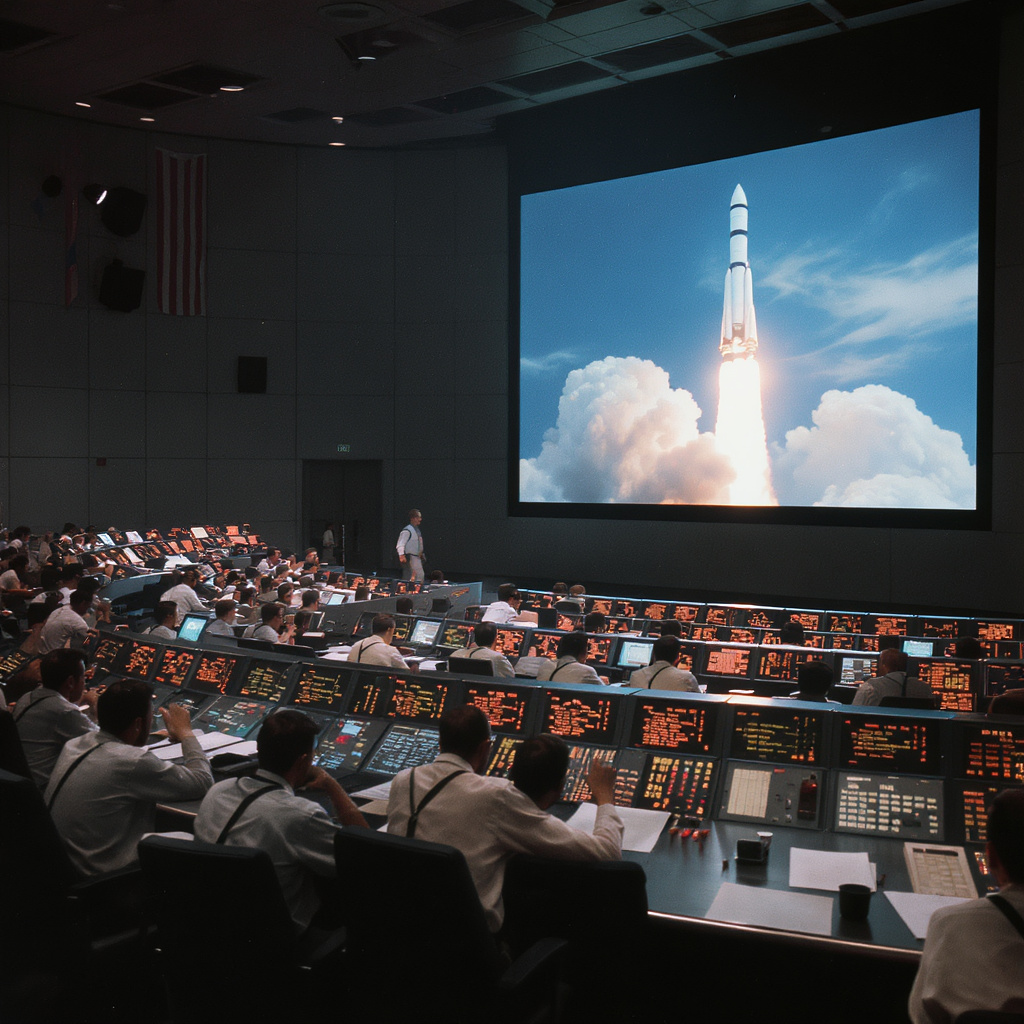
1. The Birth of a Dream – And a Scope Problem
In May 1961, President Kennedy announced an almost mythical goal:
“Before this decade is out, landing a man on the Moon and returning him safely to Earth.”
Those 20 words launched a project spanning 400,000 people, 20,000 suppliers, and a budget that peaked at 4% of the U.S. GDP.
But behind the bold promise was a project manager’s nightmare: no clear requirements, no proven technology, no defined timeline, and no roadmap.
The Apollo Program began as a dream — and had to become a deliverable.
That transformation required NASA to redefine how scope was conceptualized, communicated, and controlled.
Lesson: Scope doesn’t begin with clarity — it begins with conviction.
2. Translating Vision into Boundaries – The Power of a Single Sentence
Most projects drown in detailed charters. Apollo began with a single sentence — and made it sacred.
That sentence became the scope baseline, the north star against which every decision was tested.
NASA’s internal philosophy evolved around one powerful filter:
“Does this activity get us closer to landing a man on the Moon and bringing him back alive?”
If yes, it stayed.
If not, it was removed — no matter how innovative or appealing.
This ruthless clarity transformed a political statement into a project charter unlike any other.
Lesson: Defining scope isn’t about saying what’s included — it’s about courageously saying what’s not.
3. Progressive Elaboration – Building Clarity, Step by Step
Apollo’s scope wasn’t fully known at the beginning. It evolved through a concept called progressive elaboration — the idea that clarity grows with progress.
How NASA Did It:
- Apollo 7: First manned flight to test spacecraft systems in Earth orbit.
- Apollo 8: First crew to orbit the Moon — testing navigation and communication systems.
- Apollo 9 & 10: Rehearsed docking, re-entry, and lunar module operations.
- Apollo 11: The real mission — the culmination of all learning.
Each mission redefined the boundaries for the next. Nothing was wasted. Every “failure” became scope refinement.
Lesson: Scope management isn’t about freezing the plan — it’s about freezing the purpose.
4. Handling Scope Creep – When Curiosity Meets Control
In a project filled with geniuses, scope creep was inevitable. Scientists wanted experiments. Engineers wanted new systems. Astronauts wanted better tools.
NASA’s leadership developed a culture of scope discipline, grounded in three principles:
- Mission-Driven Decision-Making: Every subsystem was tested against the mission statement.
- Configuration Control Boards: Any proposed change went through a multi-tier review to assess impact on schedule, cost, and risk.
- Integrated Systems Thinking: Each change request had to be assessed not in isolation but in context — how it would affect downstream operations.
What emerged was not bureaucracy but clarity through constraint.
Lesson: Scope management is a leadership function, not a documentation exercise.
5. The Human Element – Managing Scope Through Purpose
Scope isn’t just technical — it’s emotional. Keeping thousands of brilliant minds focused on one mission required more than process; it required purpose.
NASA’s leaders, from Wernher von Braun to Gene Kranz, used narrative integration — storytelling as a management tool. Every engineer, coder, and supplier understood not just what they were doing, but why.
When Kranz told his team during Apollo 13,
“Failure is not an option,”
it wasn’t just a motivational line — it was a reminder of the project’s scope integrity: get them back home.
Purpose made precision possible.
Lesson: When people understand purpose, they protect the project’s scope themselves.
6. Communication Architecture – The Invisible Framework of Scope Control
NASA managed communication like a scientific process.
- Weekly integrated reviews synchronized multiple contractor teams.
- Visual tracking boards displayed current vs. expected progress.
- “Red lines” marked scope boundaries visibly in every design document.
The project’s communication structure became its control system — an early form of digital twin thinking, long before digital twins existed.
Lesson: Communication is the nervous system of scope management.
7. The Cost of Clarity – Politics, Pressure, and Priorities
Scope clarity came at a price.
Political deadlines forced technical acceleration. Budget cuts meant deferring improvements.
And yet, the Apollo Program never compromised on its mission definition — even when tragedy struck during Apollo 1’s fire. Instead of abandoning the goal, NASA used failure as scope refinement.
The project’s unwavering focus on mission boundaries is what allowed it to recover, realign, and ultimately succeed.
Lesson: Scope management isn’t about control — it’s about endurance.
8. Legacy – The Moonshot as a Metaphor for Modern Projects
Today’s digital transformations, AI rollouts, and infrastructure projects face similar challenges: unclear goals, shifting priorities, and stakeholder noise.
The Apollo Program still teaches us:
- Keep the vision sacred.
- Clarify through iteration.
- Empower teams but protect boundaries.
- Use simplicity as a superpower.
The moon landing wasn’t magic — it was structured audacity.
Lesson: Every great achievement begins with a clearly defined “why.”
9. Final Reflection – The Modern Moonshots
Every modern project manager is, in spirit, running their own Apollo. Whether it’s launching a new platform, building a data ecosystem, or transforming culture — the principle remains the same:
- Define your moon.
- Align your mission.
- Protect your scope.
- And when the noise gets loud, return to your single sentence of purpose.
Because clarity, once found, can move mountains — or land you on another one. 🌙
Leave a Reply
You must be logged in to post a comment.