
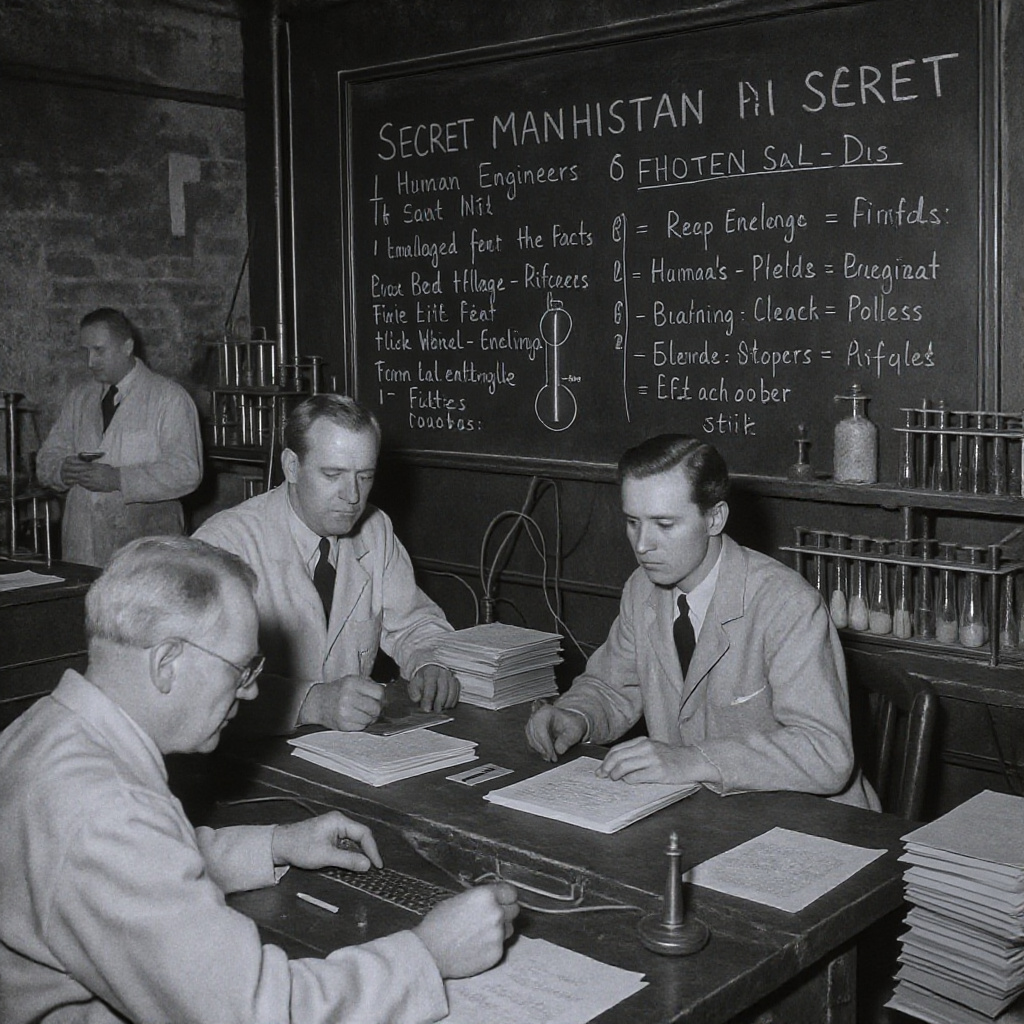
1. The Secret That Changed the World
It began not as a project — but as a fear.
In 1939, Albert Einstein and physicist Leo Szilard wrote to U.S. President Franklin D. Roosevelt, warning that Nazi Germany could be developing a new weapon based on nuclear fission. The U.S. responded with urgency — and secrecy.
By 1942, the Manhattan Project was born under the leadership of General Leslie Groves (a military commander) and Dr. J. Robert Oppenheimer (a theoretical physicist from Berkeley). Together, they managed one of the largest, most complex, and ethically charged projects in history.
At its peak, the project employed more than 130,000 people, spread across secret facilities in Los Alamos, Oak Ridge, and Hanford. Every participant knew only a fraction of the work’s purpose. The scale of coordination — without modern tools or transparency — remains staggering even today.
But beyond logistics and technology, what made the Manhattan Project extraordinary was its approach to resource management — an unrepeatable fusion of intellect, authority, and moral tension.
2. The Perfect Chaos – How They Managed the Impossible
How do you manage 130,000 people across three continents in total secrecy? The answer lies not in systems, but in principles.
a) Ruthless Prioritization
- Every decision, from procurement to manpower, was filtered through one lens: “Will it help us end the war sooner?”
- Red tape was slashed. Budgets were approved in hours. The project’s sense of purpose became its project plan.
Lesson: When objectives are existential, focus replaces bureaucracy.
b) Empowerment within Control
- Groves imposed military discipline but gave Oppenheimer near-total scientific freedom.
- Scientists were encouraged to challenge, test, and redesign — as long as they stayed within timelines.
- Sub-projects (like uranium enrichment, bomb design, and detonation testing) had autonomy to innovate rapidly.
Lesson: True leadership knows when to control and when to trust.
c) Cross-Disciplinary Fusion
- Chemists worked with physicists, engineers with mathematicians, soldiers with scientists.
- The project blurred professional hierarchies — intellect, not rank, decided influence.
Lesson: The most complex problems demand the death of silos.
d) The Human Cost of Intensity
- Many scientists lived under crushing secrecy, unable to tell families what they worked on.
- The pressure of “winning the race” led to burnout, isolation, and silent anxiety.
- Several team members, including Oppenheimer himself, later questioned the moral weight of their achievement.
Lesson: Human brilliance is not infinite — it must be protected, not exploited.
3. The Dual Faces of Leadership – Groves and Oppenheimer
At the heart of the Manhattan Project were two men — opposites in every sense.
- General Leslie Groves: The military pragmatist. Demanding, decisive, and authoritarian.
- J. Robert Oppenheimer: The intellectual idealist. Charismatic, philosophical, and emotionally complex.
Their partnership is a study in contrast — and in balance.
Groves ensured discipline, secrecy, and execution.
Oppenheimer inspired vision, creativity, and meaning.
Together, they demonstrated that resource management is not just allocation — it’s alignment.
When leaders complement each other’s weaknesses, teams thrive. When they don’t, projects fracture.
Lesson: The best-managed resources are not tools or budgets — they are human energies balanced between authority and inspiration.
4. The Ethical Storm – When Purpose Outruns Morality
After the first successful nuclear test in July 1945, codenamed Trinity, Oppenheimer stood silently and quoted the Bhagavad Gita:
“Now I am become Death, the destroyer of worlds.”
He had built the most powerful weapon in human history — and felt no triumph.
The same scientists who had worked tirelessly under patriotic urgency now struggled with guilt.
The project’s success had come at the cost of peace of mind.
From a project management lens, this is where Resource Management meets Ethics.
When people’s talents are used toward an outcome they morally question, the human resource becomes emotionally depleted — even in victory.
Lesson: The highest form of resource management is ensuring purpose and conscience remain in harmony.
5. Lessons in Modern Project Resource Management
Every organization today — from startups to governments — can learn from the Manhattan Project’s paradoxes.
a) Clarity Trumps Complexity
Even with massive teams and minimal tech, the project succeeded because everyone knew why it mattered.
In modern projects, clarity of vision often gets lost in layers of PowerPoints and KPIs.
b) Leadership Balance
Groves and Oppenheimer’s duality is a timeless model: firmness + freedom.
Micromanagement kills innovation; total freedom kills alignment. Balance creates brilliance.
c) Emotional Sustainability
Every sprint, crisis, and deadline burns energy. Leaders must plan not just for resource utilization, but human rejuvenation.
Motivation is renewable only when empathy fuels it.
d) Confidentiality vs. Transparency
The Manhattan Project thrived on secrecy — but modern projects thrive on openness.
Managers must know when to shield information and when to share it. Transparency builds trust; secrecy breeds suspicion.
e) The Moral Dimension of Projects
Every project creates change — sometimes for good, sometimes not.
Project managers must ask: “Are we building something worth its consequences?”
6. Aftermath – The Legacy of Leadership and Guilt
After Hiroshima and Nagasaki, Oppenheimer became a symbol of scientific conscience. He opposed further nuclear arms development — leading to political persecution.
Groves, meanwhile, was praised for his logistical brilliance but criticized for his secrecy and rigidity.
The Manhattan Project ended, but its management model influenced every large-scale scientific initiative that followed — from NASA’s Apollo missions to CERN’s particle colliders.
It taught the world that coordination is power, but wisdom is restraint.
7. Closing Reflections – Managing the Human Within the Resource
In every project, people carry both potential and burden. The Manhattan Project shows that when human brilliance is compressed by secrecy, urgency, and ambition — it creates miracles and moral scars alike.
Project Resource Management isn’t just about allocating hours or tracking productivity. It’s about:
- Understanding human motivation.
- Guarding against burnout.
- Aligning ethics with execution.
- Leading with purpose, not pressure.
When Oppenheimer watched the mushroom cloud rise, he didn’t see victory — he saw consequence.
And that’s what every leader should remember:
When you manage people, you don’t just build outcomes — you build history.
Leave a Reply
You must be logged in to post a comment.